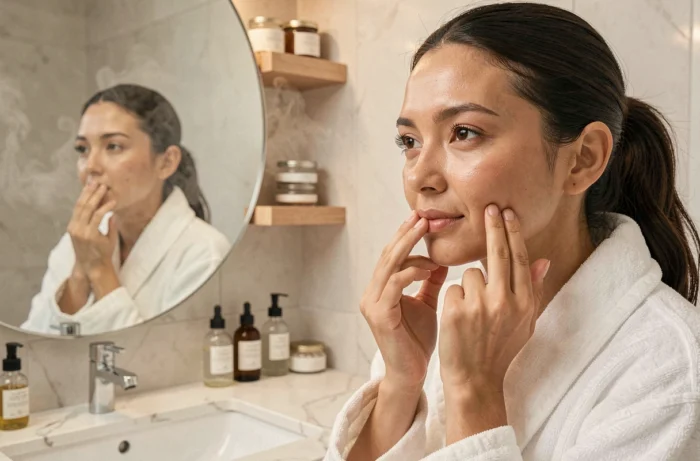
A skincare routine encompasses all the gestures and products applied to the skin, hair, or lips in a specific order. The effectiveness of each formula largely depends on its place in the sequence: a serum applied to unclean skin penetrates poorly, while a moisturizer applied before a targeted treatment dilutes the active ingredients. Understanding the logic of this sequence changes the results more than accumulating expensive references.
Order of application of cosmetic products for the face
The basic rule is based on texture: we progress from the thinnest to the thickest. This physical principle allows each layer to pass through the previous one without creating a premature occlusive film.
- The cleanser (gel, foam, or cleansing oil) removes sebum, makeup residue, and accumulated particles. It prepares the skin to receive the following actives.
- The serum, formulated in a concentrated aqueous phase, targets a specific need (radiance, firmness, deep hydration). Its fine texture allows it to penetrate before creams.
- The moisturizer seals in hydration and restores the skin barrier. In the morning, it also serves as a base before sun protection.
- The sunscreen, the last step in the morning, forms a shield against UV rays. If applied too early in the sequence, it prevents the previous treatments from penetrating properly.
In the evening, sunscreen is removed from the sequence. The eye contour, which is thinner than the rest of the face, is treated with a dedicated product, applied by gentle tapping after the serum and before the cream.
By browsing all the sections of Cosmétiques Beauté, one quickly notices that each category of product corresponds to a specific step in this sequence, from cleansing to protection.
Reading the INCI list: allergens and microplastics on the label
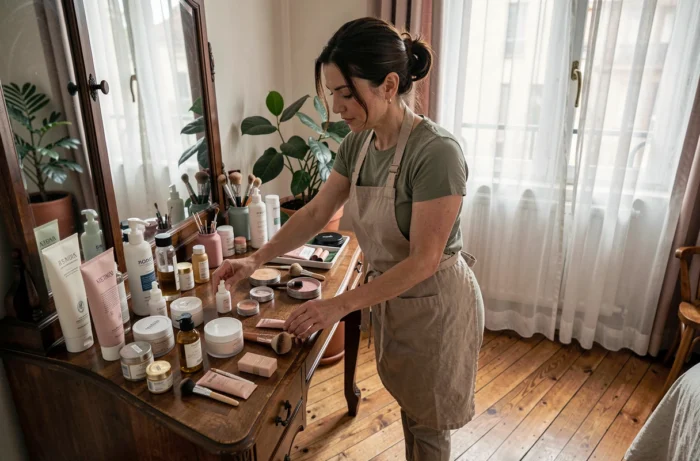
The INCI list (International Nomenclature of Cosmetic Ingredients) appears on every package as a regulatory requirement. Ingredients are listed in descending order of concentration. Knowing how to read it allows for evaluating a product before integrating it into one’s routine.
New rules on fragrance allergens
Regulation (EU) 2023/1545 expands the list of individually declared allergens on the label. For products placed on the market from July 31, 2026, manufacturers must display these substances distinctly. Non-compliant stocks can still be sold until July 31, 2028.
For sensitive skin, this development represents an increase in readability. Spotting an allergen in the INCI list will be simpler, helping to rule out a problematic product before purchase rather than after a skin reaction.
Gradual restriction of microplastics
The European Union is implementing a schedule for restricting microplastics by category. Rinse-off cosmetics (shower gels, exfoliating shampoos) have a transitional period until October 2027. Leave-on products, such as creams and serums, have until October 2029. Makeup, lip, and nail products benefit from the longest deadline, until October 2035.
This schedule means that not all products in a routine will change formulation at the same time. Checking for terms like “acrylates copolymer” or “polyethylene” in the INCI list remains relevant for those wishing to anticipate these restrictions.
Hair and lip care: adapting the logic to each area
The skin of the face is not the only area that requires a logical sequence. Hair and lips respond to different constraints, but the principle of sequencing applies here as well.
Hair: cleansing, treatment, finishing
A shampoo suitable for the scalp type (oily, dry, sensitized) forms the base. Conditioner or a mask then follows to coat the fiber. A hair serum is applied to towel-dried hair, never to dry hair, to facilitate product distribution and absorption of actives.
Hair oil, being more occlusive, is placed as the last step to seal in hydration. Reversing the order (oil before serum) creates a greasy layer that prevents penetration.
Lips: an often-neglected area
The skin of the lips does not have sebaceous glands. It therefore dehydrates faster than the rest of the face. A lip balm rich in emollient agents (shea butter, beeswax) protects this fragile area. Applying it after the facial serum and before the moisturizer ensures it is not forgotten in the routine.
Labeling in French and checks before purchase
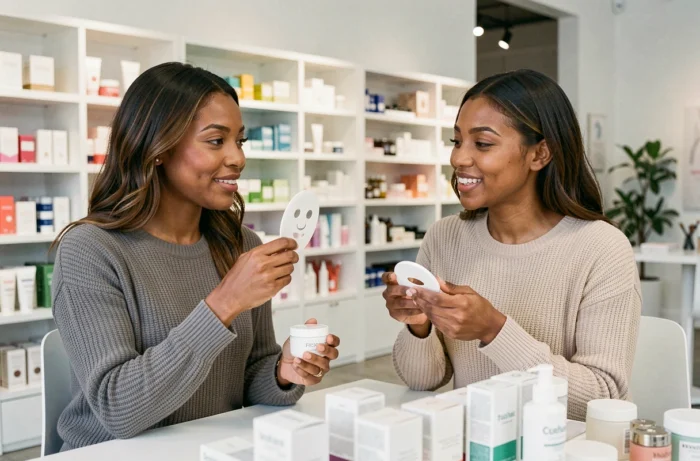
French regulations require that information on the packaging be written in French. This includes usage precautions, the product’s function, and conditions of use. A product whose label does not contain any mention in French is not compliant with consumer law.
Before adding a cosmetic to one’s routine, three points deserve a quick check: the presence of the complete INCI list, the durability date (the open pot symbol indicating the duration of use after opening), and the mention of the country of manufacture or the responsible party for marketing in the EU.
An expired or poorly stored product loses effectiveness and can irritate the skin. A serum opened longer than the duration indicated on the open pot must be replaced, even if there is still product left in the bottle.
Building an effective routine relies less on the number of products than on their order of application and the quality of their formulations. European regulatory developments on allergens and microplastics make reading labels more accessible each year. Checking the INCI list before each purchase remains the most cost-effective gesture for the skin.