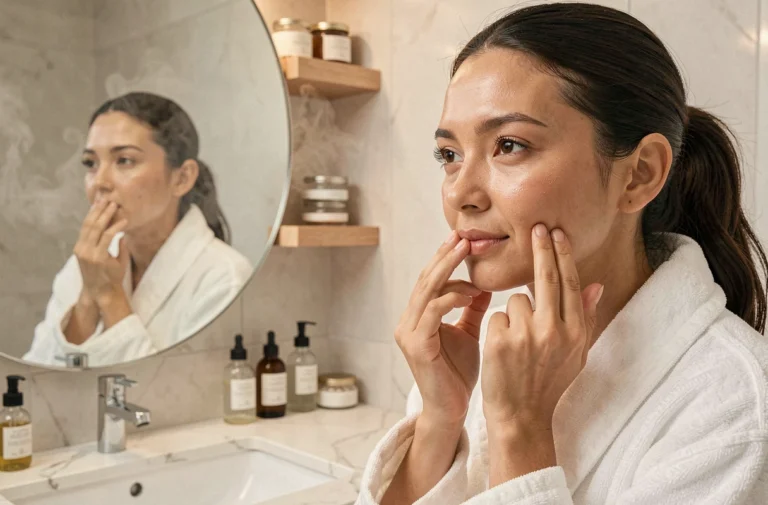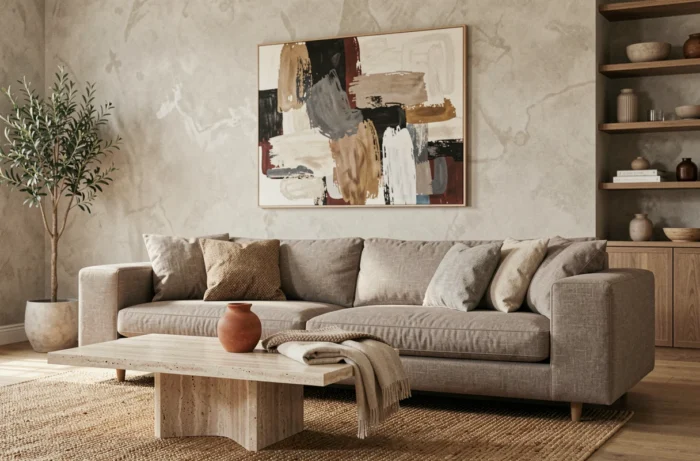
Earthy palettes and raw materials are no longer sufficient to define a contemporary interior. Modern home decoration in 2026 is structured around precise technical choices: matte finishes on natural stone, compartmentalization of open spaces, furniture designed to last multiple life cycles. Each material decision impacts the longevity of the layout as much as its aesthetics.
Natural stone beyond the countertop: uses and finishes
Natural stone is moving beyond just kitchen countertops. The fall 2026 trend report from Houzz notes its use in sinks, furniture, and even lighting. This shift alters technical constraints: a monolithic sink in marble or travertine requires a matte or honed finish to limit water marks and facilitate regular maintenance.
Matte surfaces are also gaining ground in wall coverings. A stone veneer with a brushed finish absorbs light instead of reflecting it, which reduces unwanted glare in highly glazed rooms. The choice of water-repellent treatment remains crucial: without appropriate impregnation, the natural porosity of the stone turns a decorative element into a source of permanent stains.
We see designers now integrating stone into pendant lighting, where the translucency of onyx or alabaster replaces frosted glass. The effect produced diffuses a warm light that is difficult to replicate with synthetic materials.
Exploring a modern decoration approach with Bossa Studio Déco allows one to measure how these materials come together in a comprehensive project, from the floor to the suspensions.
Compartmentalized kitchen: hiding functions without closing off the space
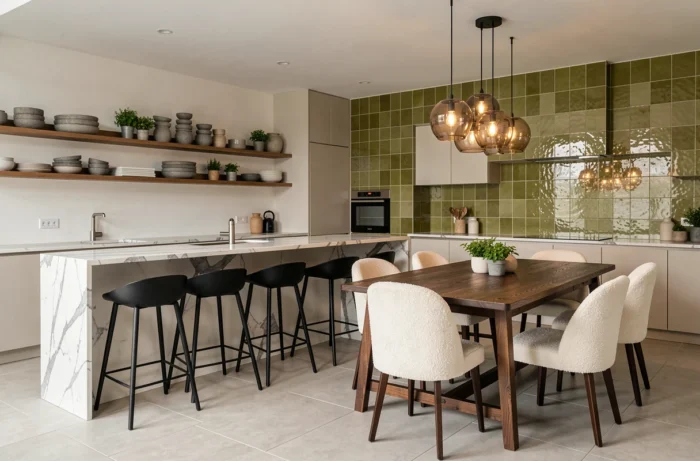
The open kitchen is partially closing off. The 2026 trend introduces hidden service areas, often referred to as “back kitchens,” which separate messy preparation from the visible reception island. The plan remains open, but bulky appliances (mixer, fryer, drying rack) disappear behind a low partition or a flush sliding door system.
This compartmentalization addresses a concrete problem: range hoods struggle to manage odors in a large open volume. Isolating the cooking area behind a fixed or sliding glass wall reduces the spread of grease and vapors into the living room, without sacrificing the visual connection between rooms.
Preferred separation materials
- Fluted or ribbed glass: filters the view of cluttered countertops while allowing natural light to pass through. Common thickness around 8 mm for a fixed partition.
- Matte lacquered metal (black, olive green, terracotta): fine structure that also serves as a magnetic support for kitchen accessories. Easy maintenance, resistant to splashes.
- Slatted wood (oak or ash): creates a perforated visual filter. The spacing between the slats determines the degree of obscuration; a tight spacing masks more without blocking air circulation.
The choice of separation material conditions the atmosphere of the entire living space. A fluted glass partition maintains a sleek design style, while slatted wood leans towards a more organic atmosphere.
Multigenerational furniture: designing for multiple life stages
The 2026 U.S. Houzz & Home Study indicates that homeowners often plan to stay long after renovations. Professionals describe spaces designed for multiple uses and life stages: secondary suites to host relatives, layouts intended to remain comfortable over time.
This principle alters the specifications for furniture. A multigenerational piece is defined by its modularity and reparability, not just by its sturdiness. An extendable solid wood table with integrated leaves serves both a dinner for two and an expanded family meal. Adjustable-height seating or repositionable modular sofas serve the same adaptability goal.
Second-hand as a style lever
Second-hand is no longer just an economic approach. Vinterior reports an annual increase in its sales to designers, indicating that vintage is becoming a style choice embraced by professionals. Integrating a found piece (1960s sideboard, period brass floor lamp) into a contemporary interior creates a contrast of textures and patinas that no new furniture can replicate.
The condition: check the structure of the furniture before purchase. A dovetail drawer lasts decades, while a stapled assembly gives way in a few months. The quality of the original carpentry remains the primary selection criterion.
Colors and light: balancing between neutral tones and warm accents
Earthy colors (terracotta, ochre, brown) dominate the 2026 palette, laid on a base of timeless neutral tones (off-white, greige, light gray). A common mistake is to multiply warm accents on all surfaces: the result overwhelms the space instead of structuring it.
A single accent wall in a saturated hue is enough to anchor the chromatic identity of a room. The rest of the surfaces benefit from maintaining light tones to enhance light reflection. In a north-facing living room, a deep ochre on the wall facing the window captures and redistributes natural light better than pure white, which will appear grayish.
- Terracotta: works as a flat color on a single wall or in small touches (cushions, ceramics). Pair with ecru linen to avoid saturation.
- Olive green: a shade that adapts to woodwork and lacquered furniture. Pairs well with brushed brass and light wood.
- Chocolate brown: reserved for bright rooms or occasional elements (mirror frame, lamp base). Risks darkening an already constrained space.
Indirect lighting remains the necessary complement to a dark palette. LED strips recessed under low furniture or along cornices compensate for the loss of brightness without adding a visible source. A color temperature around 2,700 K preserves the warmth of earthy tones without turning yellow.
Modern home decoration is less about the accumulation of trends and more about the coherence between materials, light, and functionality. An interior designed to last absorbs trends without succumbing to them, which ultimately remains the true marker of elegance.