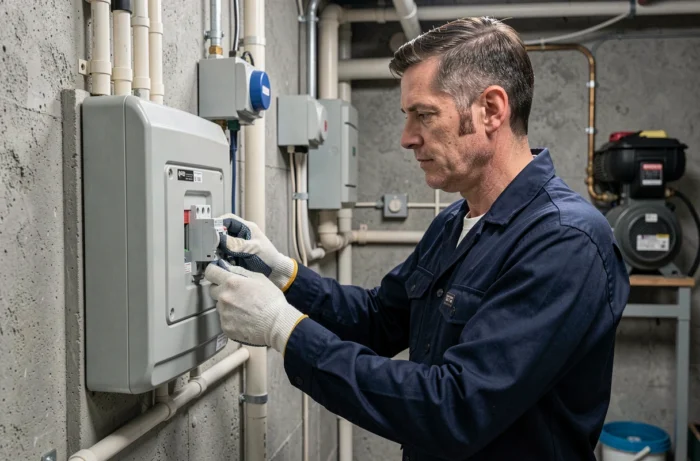
The rating of a circuit breaker for a pool equipment room should not be chosen based on the pump’s product specifications alone. It must be determined by considering the power rating of each load, the cross-sectional area of the supply cable, the line length, and the type of residual-current protection required by the NF C 15-100 standard. Incorrect sizing can cause nuisance tripping or, worse, ineffective protection on a circuit exposed to constant moisture.
Voltage drop on a long line: what the breaker rating alone cannot fix
An equipment room located several dozen metres from the main panel changes the equation considerably. Cable resistance increases with distance, reducing the voltage available at the pump terminals. On a single-phase line using 3G6 mm² cable, the voltage drop can exceed the regulatory limit of 5% well before 50 m.
Switching to 3G10 mm² cable then becomes essential to keep the voltage within tolerance. This is not a matter of convenience: an underpowered pump motor draws a higher starting current, putting more strain on the upstream circuit breaker and potentially causing nuisance magnetic tripping.
Choosing a circuit breaker suited to a pool equipment room therefore means checking the voltage drop before selecting the rating. A 16 A circuit breaker at the start of the line protects the cable, but does not guarantee that the motor receives enough voltage to start without an overcurrent.
Coordination takes place in two stages: a branch circuit breaker in the main panel, sized for the cable cross-section (16 A for 2.5 mm², 32 A for 6 mm², 40 A for 10 mm²), followed by terminal protection devices in the equipment room panel, rated for each piece of equipment.
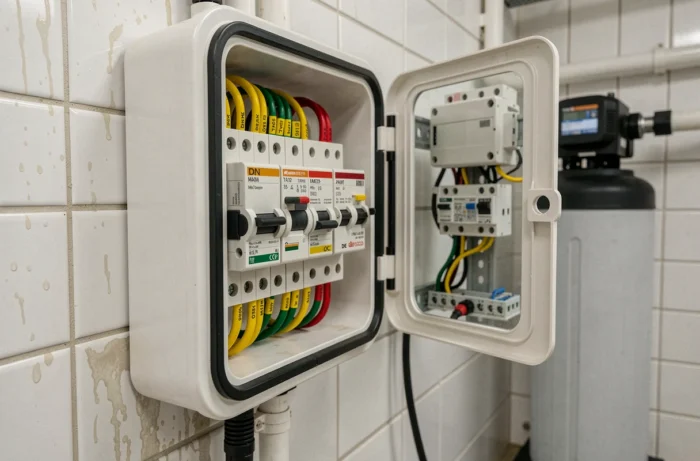
30 mA residual-current protection in the pool equipment room: RCD or RCBO
The NF C 15-100 standard requires a 30 mA Type A or AC residual-current device upstream of every circuit supplying pool equipment. Where to install it is less straightforward than it might seem: should the equipment room panel have an RCD, an RCBO on each circuit, or both?
For a remote equipment room, we recommend installing a 30 mA RCD upstream of the subpanel, with individual thermal-magnetic circuit breakers downstream. This setup offers a practical advantage: if an insulation fault occurs on a single piece of equipment, the branch circuit breaker cuts off the faulty circuit without shutting down the filtration or treatment system.
A combined RCBO (thermal-magnetic and 30 mA residual-current protection) is still a suitable option when the equipment room has only one circuit, typically for a filtration pump alone. As soon as there is a submerged light, a salt chlorinator or a heat pump, circuit selectivity makes a structured subpanel the better choice.
Selectivity between the main panel and the pool subpanel
The 30 mA RCD in the equipment room must coordinate with the upstream RCD in the main panel, which is generally rated at 300 mA or is a Type S (selective) device. If both are instantaneous 30 mA devices, they will trip simultaneously at the slightest fault, cutting power to the entire home. The upstream RCD must therefore have either a higher sensitivity threshold or a selective (time-delayed) response, allowing the equipment room’s 30 mA device to trip first.
Circuit breaker rating by equipment: pump, lighting, salt chlorinator
The calculation is straightforward for single-phase power: divide the rated power by 230 V, then round up to the next standard rating. A 1,500 W filtration pump draws around 6.5 A. A 10 A Type C circuit breaker is sufficient for this circuit, with enough headroom to handle the starting current, which can reach three to five times the rated current for a fraction of a second.
- Filtration pump (750 W to 1,500 W): 10 A circuit breaker with 2.5 mm² cable, or 16 A if the pump exceeds 2,000 W.
- Low-voltage submerged light (via a SELV safety transformer): 2 A or 6 A circuit breaker, depending on the transformer’s power rating, with a minimum cable cross-section of 1.5 mm².
- Salt chlorinator: 10 A or 16 A circuit breaker, depending on the model, on a dedicated circuit with its own 30 mA RCD if required by the manufacturer.
- Heat pump: 20 A or 32 A circuit breaker, depending on the power drawn, with 4 mm² or 6 mm² cable and a contactor if specified in the instructions.
Each piece of equipment must have its own circuit breaker. Combining the pump and lighting on the same circuit is a common mistake that makes it impossible to diagnose a trip and goes against the standard’s requirement for one circuit per function.
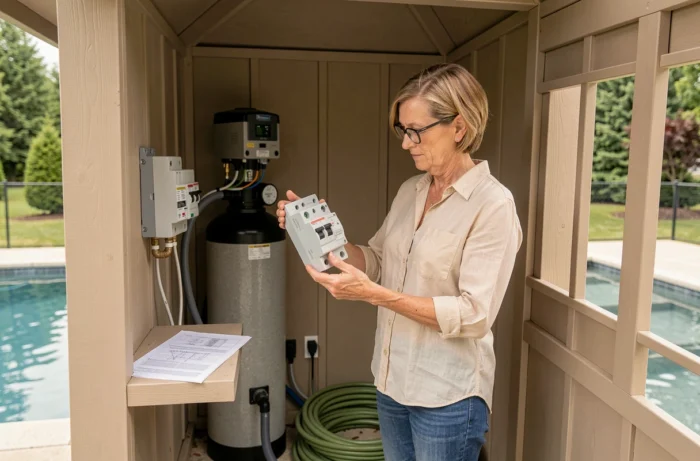
Pool electrical panel: ingress protection rating and connection
The panel installed in the equipment room must have an IP rating of at least IP55 if the room is not fully enclosed, or IP30 in a closed, ventilated room. A panel with too few module spaces forces cables to be packed tightly, which can compromise connections and make future maintenance more difficult.
Allowing for at least two spare modules makes it possible to add a circuit without replacing the panel. Pool equipment rooms often need an additional device after commissioning, such as a booster pump for a pool cleaner, solar heating or a pH regulator.
Connection to the main panel
The supply from the main panel to the pool equipment room runs from a dedicated branch circuit breaker, installed downstream of an existing or dedicated RCD. The cable cross-section between the two panels depends on the distance and the combined power demand of all the equipment in the room. For distances of several dozen metres, 3G10 mm² R2V cable protected by a 40 A circuit breaker remains the most common setup.
The cable must be laid in a trench at a minimum depth of 50 cm inside a red TPC conduit (power circuit), or surface-mounted on cable tray in a crawl space. ICTA conduit is reserved for indoor runs.
An incorrectly rated circuit breaker or an undersized cable on a long line may not cause problems straight away. The issue tends to appear in midsummer, when the pump runs continuously and the cable temperature rises. Checking that the breaker rating, cable cross-section and line length are compatible before filling the pool is the best investment in equipment room safety.