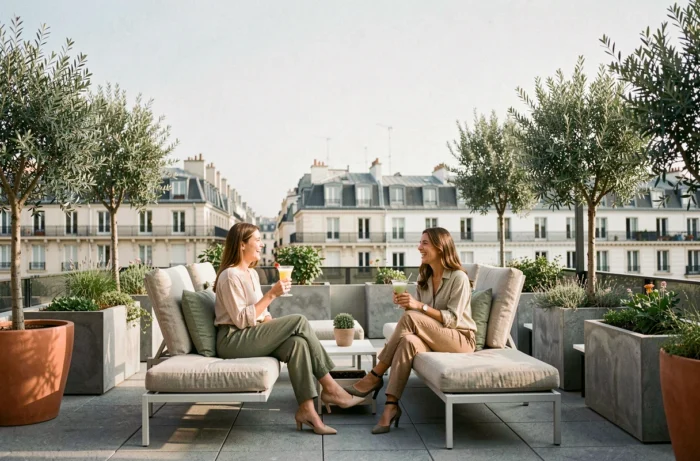
Rooftops in city centres are about more than panoramic views and cocktails in hand. Behind every elevated terrace lies a strict regulatory framework, roof-related thermal constraints and accessibility considerations that shape the experience just as much as the furniture or drinks menu. The trend is spreading across France’s major cities, led by Paris, as well as regional hubs where property pressures are driving operators to make use of rooftops.
ERP requirements and accessibility for a rooftop open to the public
A rooftop that welcomes customers is more than just a converted roof. It is subject to regulations governing establishments open to the public (ERP), which set out requirements for access, evacuation and exit routes based on the venue’s classification. The route from the street to the terrace must include emergency exits sized to accommodate the number of people on site.
Access for people with reduced mobility is a common sticking point. Many older buildings in city centres do not have a suitable lift to the top floor, which effectively limits their clientele. When asking what is a rooftop in the city centre, the answer also involves these practical realities: the design of the venue must account for visitor flow, safety and inclusivity before anyone even thinks about the decor.
Since 1 August 2025, Article CH 40 of the ERP safety regulations has set out requirements for rooftop monobloc units, including measures to protect the structure from radiant heat in the event of a fire. Ventilation, heating and cooling equipment installed on the roof must be factored into the project, even if customers never see it. Operators who overlook this aspect risk receiving formal notices during safety inspections.
Greening and cooling a rooftop terrace: what real-world experience shows
The promise of a “cooling” rooftop deserves closer scrutiny. Adding plants to a roof does not guarantee lasting thermal comfort. Experience with green roofs shows that the cooling effect depends on water availability and maintenance during periods of extreme heat. In the height of summer, dry growing medium loses most of its ability to cool through evapotranspiration.
Reflective white paint, another solution sometimes promoted, also has its limitations. Early observations suggest that its reflectivity can diminish over time, while shade (pergolas, shade sails and tall shrubs) appears to do more to improve how comfortable customers feel.
Managing water on rooftops
A green roof uses water. In city centres, connecting to a rainwater harvesting system can offset some of the watering needs, but storage capacity on a roof remains limited. The balance between ambitious planting and controlled water consumption determines whether a project is viable in the long term.
For a bar or restaurant with a terrace, the issue is about more than aesthetics. A green space that turns yellow in August sends the opposite message to the one the venue wants to convey. The most conscientious operators set aside a dedicated horticultural maintenance budget and choose drought-resistant species rather than water-hungry grasses.
Rooftop bars and restaurants: what sets an elevated terrace apart from an ordinary roof
The view is the main draw, but it is not enough to keep customers coming back. A few practical factors make the difference between a rooftop that lasts and a short-lived venue:
- Sound insulation from street noise and the building’s technical equipment, which determines how comfortable it is to hold a conversation in the evening
- Protection from the wind, which is often underestimated: on some days, serving customers is almost impossible on a seventh-floor terrace without windbreaks
- Service logistics, since carrying food and drinks up from a kitchen several floors below increases waiting times and makes it harder to manage customer flow
In Paris, venues such as Le Perchoir have popularised the concept of a rooftop bar with views over the rooftops. The model has spread to Bordeaux, Lyon, Marseille and Nantes. Each city brings its own architectural and climatic challenges. A rooftop in Nantes has to contend with rain, while a venue in Marseille has to deal with the mistral.
Reservations and access: the experience begins before you arrive
Most urban rooftops operate on a reservation basis, especially at weekends. This helps manage the capacity limits set by the ERP classification, but it also changes the nature of the venue. A rooftop that requires reservations is more like a restaurant than a neighbourhood bar where people drop in spontaneously.
Physical access deserves careful consideration. A narrow staircase, a slow lift or a maze-like route through an office building can dampen the excitement. The customer journey to the terrace is part of the experience, and operators who pay attention to signage and lighting in shared areas gain an advantage.
Rooftops and urban heat: a place to unwind or a temperature amplifier?
City rooftops absorb and release heat. Without enough shade, a rooftop can become uncomfortable once temperatures pass a certain threshold. Operators need to turn an elevated spot, naturally exposed to the sun, into a space where people can still relax in the height of summer.
Effective solutions combine several approaches: mechanical shading (shade sails and bioclimatic pergolas), targeted misting and light-coloured flooring that limits heat build-up. A well-designed rooftop helps mitigate the urban heat island effect rather than intensifying it.
The question remains open for terraces that rely solely on planting without providing additional shade. In cities where heatwaves are becoming more frequent, the long-term viability of an elevated terrace concept depends as much on climate engineering as on the cocktail menu. A rooftop that closes during every heatwave loses its purpose as a summer destination.


