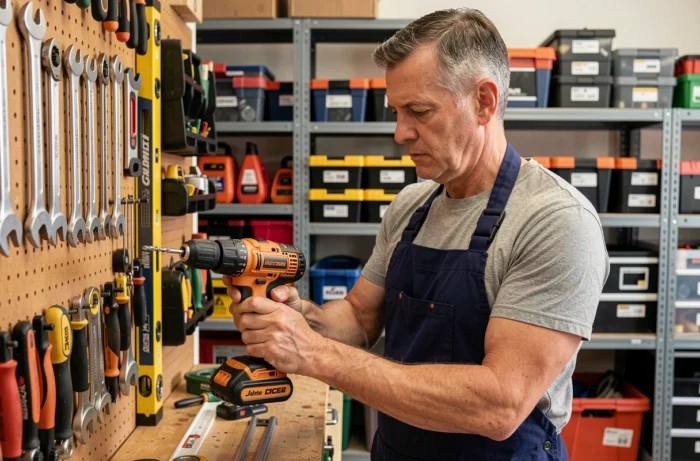
The French power tool market is changing: cordless models are accounting for an increasing share of sales, European battery regulations are evolving, and repairability is becoming a factor in purchasing decisions. Choosing the right DIY equipment is no longer just a matter of comparing prices in store. The type of work, the motor, the lifespan of consumables, and even whether to rent rather than buy all influence the decision.
Battery compatibility: the hidden pitfall of cordless tools
The rise of cordless tools has reshuffled priorities. A drill-driver, jigsaw and sander that all run on the same battery platform reduce overall costs and clutter. By contrast, using multiple brands means accumulating incompatible chargers and batteries that have no other use.
Before buying, make a habit of checking the manufacturer’s compatibility range. Batteries are not interchangeable between brands, even when the voltage appears to be the same. Voltage, connectors and battery management electronics vary from one system to another.
From February 18, 2027, European Regulation (EU) 2023/1542 will introduce requirements for the removal and replacement of certain portable batteries. For DIYers investing today, this makes it worth prioritizing tools whose batteries and spare parts remain available and replaceable.
A product range offering a wide selection of tools that use the same battery helps protect your investment for years to come. Among the equipment featured on Blog du Bricoleur, this platform-based approach is regularly explained to help readers compare ecosystems.
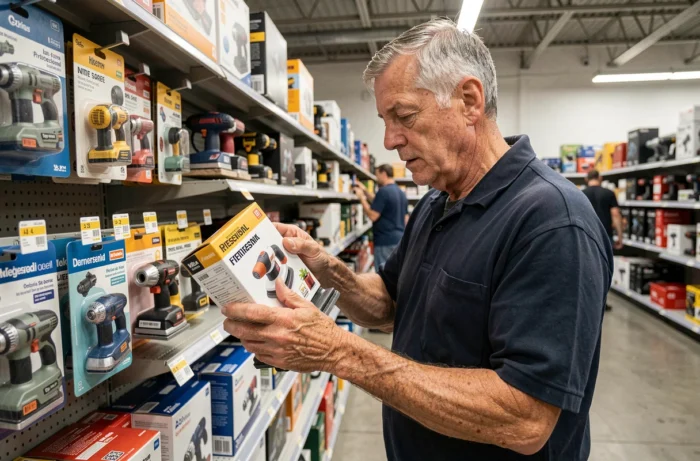
Renting, buying second-hand or buying new: an often-overlooked trade-off
Most guides steer readers straight toward buying new. This overlooks a simple reality: some tools are only used for a few hours a year. A wall chaser for embedding electrical conduits, a rotary hammer for breaking down a partition, a router for a one-off woodworking project—these tools cost several hundred euros and then sit unused in the garage.
Renting avoids tying up money in a tool you rarely use. DIY retailers and peer-to-peer rental platforms now offer extensive catalogs, often including professional-grade models that outperform those sold to consumers.
Buying second-hand is also worth considering. A used corded tool (circular saw, angle grinder) can remain functional for a long time if the motor and cable are in good condition. With cordless tools, however, caution is needed: the capacity of a lithium-ion battery declines with charge cycles, and a worn battery can halve runtime without showing any visible signs of wear.
- Rent: suitable for specialist tools used fewer than two or three times a year (wall chaser, industrial heat gun, cement mixer).
- Second-hand: a good option for robust corded tools (angle grinder, circular saw), provided you check the cable and motor brushes.
- Buy new: worthwhile for tools used regularly (drill-driver, jigsaw) and for building a compatible battery ecosystem.
DIY protection and safety: what home improvers overlook
Personal protective equipment is rarely treated as a proper budget item, but it should be. Safety glasses, gloves suited to the task, hearing protection and a dust mask are not optional accessories.
Noise, dust and vibration are dangers people tend to take for granted. An angle grinder can easily exceed safe noise levels. Depending on the wood species, wood dust can be irritating or allergenic. Repeated vibration from a rotary hammer puts far more strain on the joints than immediate fatigue might suggest.
Choosing protection to suit the task makes all the difference. An FFP2 mask for sanding does not serve the same purpose as a cartridge respirator for paint or solvents. Cut-resistant gloves are suitable for handling sheet metal, but can hinder precision woodworking. The right safety gear is the gear suited to the task—not a one-size-fits-all model bought by default.
Hand tools and measuring tools: the essentials power tools cannot replace
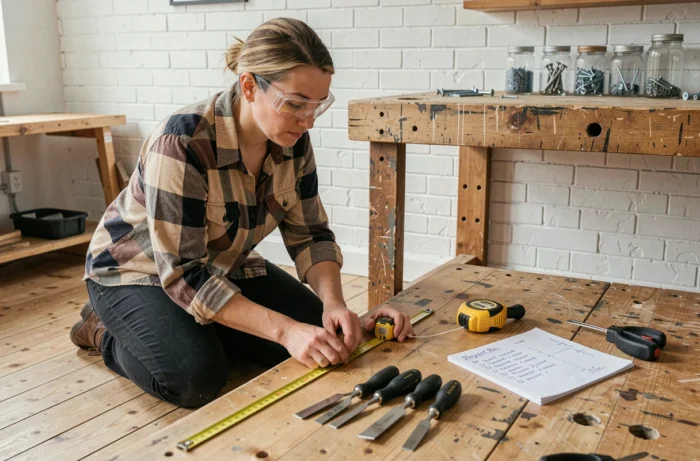
The appeal of power tools can sometimes make us forget that good workmanship starts with accurate measuring and marking. A reliable tape measure, spirit level, carpenter’s square and carpenter’s pencil cost little and have a direct impact on the final result.
A clean cut starts with an accurate mark. No saw, however high-end, can correct a poorly marked line. Investing in a quality tape measure (with a stiff blade, reliable lock and clear markings) and an accurate level is still the foundation of any workshop.
The same principle applies to hand tools as to power tools: a set of screwdrivers with a range of tips, slip-joint pliers, a well-balanced hammer and a set of Allen keys cover most everyday jobs. Steel quality and handle ergonomics make a difference over time. A screwdriver with a tip that rounds off after just a few screws damages fastener heads and makes every subsequent task more difficult.
- Measuring and marking: tape measure with a stiff blade, spirit level, carpenter’s square, carpenter’s pencil.
- Fastening and holding: screwdriver set (flathead, Phillips, Torx), slip-joint pliers, adjustable wrench, Allen key set.
- Striking and levering: carpenter’s hammer, rubber mallet for delicate joints.
- Manual cutting: retractable-blade utility knife, hacksaw, hand saw for wood.
Building a functional DIY workshop comes down to practical choices: stick to a compatible battery ecosystem, weigh renting against buying based on how often a tool will be used, treat personal protective equipment as a budget item in its own right, and don’t underestimate basic hand tools. A tool suited to the project and properly maintained will last for years—the only criterion that really matters in the long run.


