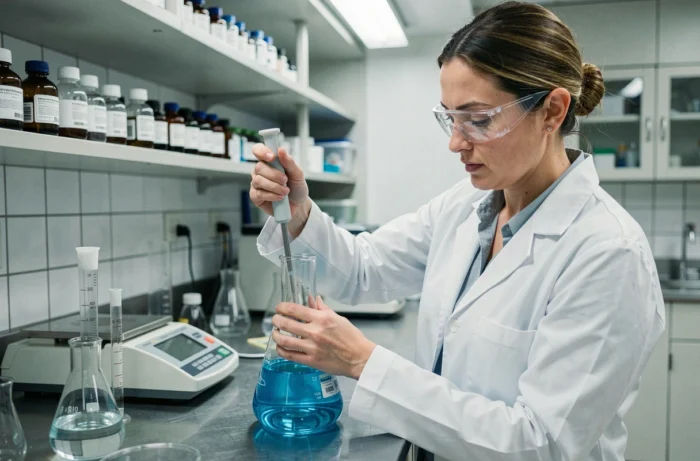
Mass concentration, volume concentration, and mass/volume percentage: these three terms refer to distinct quantities, and confusing them can throw off a calculation from the very first step. The method used to calculate concentration depends on what is being measured (the mass or volume of the solute), the type of mixture (a solid in a liquid or one liquid in another), and the experimental conditions, particularly temperature.
Mass and volume concentration: a comparison table
| Criterion | Mass concentration (g/L or % m/V) | Volume concentration (% V/V) | Mass percentage (% m/m) |
|---|---|---|---|
| Quantity in the numerator | Mass of solute | Volume of solute | Mass of solute |
| Quantity in the denominator | Volume of solution | Volume of solution | Mass of solution |
| Common unit | g/L or g per 100 mL | mL/L or % | % (dimensionless) |
| Temperature sensitivity | Yes (volume changes) | Yes (volume changes) | No (masses remain constant) |
| Typical use | Solid dissolved in a liquid | Liquid mixed with a liquid | Industrial formulations, pharmacopoeia |
The row on temperature sensitivity is often overlooked. Any quantity with a volume in the denominator changes when the temperature fluctuates, because the solution expands or contracts as its density changes. A result expressed as a mass percentage (m/m) remains stable regardless of the ambient temperature.
To explore the difference between mass and volume concentration in more detail, it is important to understand that converting from one to the other always requires the solution’s density under the measurement conditions.

Calculation formula: when the solution’s density changes everything
Mass concentration is calculated by dividing the mass of solute by the total volume of solution. In shorthand: C = mass of solute divided by volume of solution. The result is expressed in g/L.
Mass percentage, on the other hand, is calculated by dividing the mass of solute by the total mass of the solution, then multiplying by one hundred. No volume is involved.
The pitfall arises during conversion. It is sometimes stated that, in a dilute aqueous solution, expressing a concentration in mg/L is equivalent to expressing it in ppm (parts per million). This equivalence assumes that the solution’s density is exactly the same as that of pure water. For a concentrated solution or a non-aqueous solvent, the approximation mg/L = ppm is incorrect.
Converting between mass percentage and g/L
Converting a mass percentage to a concentration in g/L requires the solution’s density. The formula links the two quantities: concentration (g/L) = mass percentage multiplied by the solution’s density (in g/L), divided by one hundred.
Without this density value, measured at the working temperature, the conversion will produce an incorrect result. A digital densimeter or pycnometer can provide the measurement, but the result is valid only at the temperature at which it was taken.
Temperature and choice of unit: a criterion often overlooked in chemistry
Molarity (mol/L) and mass concentration (g/L) share the same drawback: their values vary with temperature because the volume of the solution expands or contracts.
Molality (mol/kg of solvent) and mass percentage (% m/m) do not depend on volume. They remain constant as long as the composition of the mixture does not change.
- Working at a controlled temperature (using a laboratory thermostat): concentration in g/L or mol/L is suitable, since the volume remains reproducible from one measurement to the next.
- Variable-temperature conditions (storage, transport, fieldwork): expressing concentration as a mass percentage avoids errors caused by expansion.
- Comparing preparations made at different temperatures: molality or % m/m allows comparisons without recalculating the density at each measurement point.
This is not a trivial consideration. Chemical regulations may specify concentration thresholds as mass percentages precisely to avoid ambiguity related to measurement conditions.
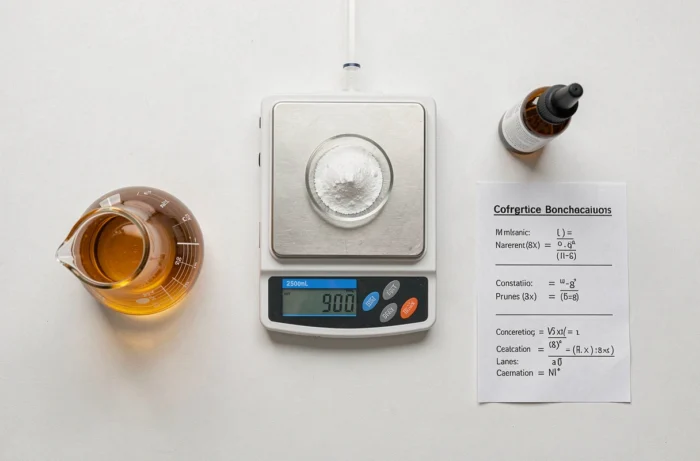
Mass percentage, volume percentage, or % m/V: three expressions not to confuse
The % sign alone does not indicate which calculation method is being used. Three conventions coexist, and omitting the notation m/m, V/V, or m/V is the most common source of error in a problem or safety data sheet.
- Mass percentage (% m/m) is the mass of solute relative to the total mass of the solution. It does not depend on volume, and therefore is not affected by temperature.
- Volume percentage (% V/V) is the volume of solute relative to the total volume of the solution. It is used for mixtures of miscible liquids (ethanol in water, for example).
- Mass/volume percentage (% m/V) expresses the mass of solute (in grams) per 100 mL of solution. It is a mass concentration disguised as a percentage, and converting it to mol/L requires the solute’s molar mass.
Which percentage for which context?
In analytical chemistry, % m/m is preferred when precision is paramount, because weighing is more reproducible than measuring a volume. In pharmacy and biology, % m/V remains common for dilute aqueous solutions. In winemaking and the beverage industry, % V/V is used to express alcohol content.
The choice is therefore not arbitrary. It depends on the physical nature of the solute (solid or liquid), the required precision, and the standard applicable to the industry.
Weighing provides mass-based quantities, while glassware provides volume-based quantities, but the preparation method alone does not determine the final unit. A solution can be prepared by weighing and the result expressed in g/L, provided the final volume of the solution is known.
Choosing between mass and volume concentration comes down to asking three questions: Is the solute a solid or a liquid? Is the working temperature stable? And which standard governs how the result should be expressed? Answering these questions before starting a calculation helps prevent most conversion errors.


