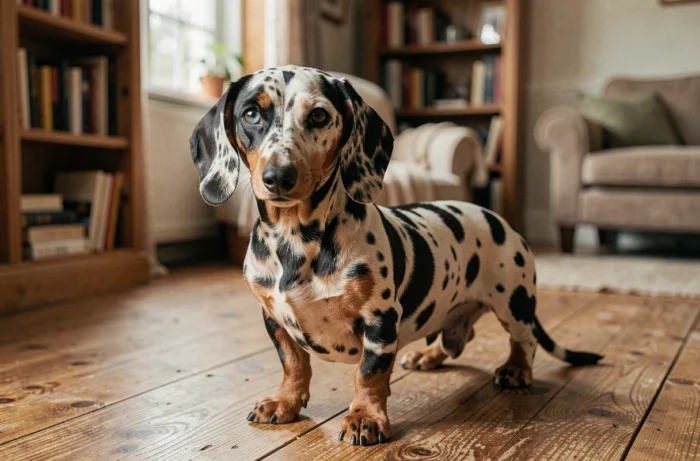
The miniature dapple Dachshund has a coat pattern known as dapple (merle), with irregular patches against a darker background. This is purely a pigmentation trait: the dapple coat does not determine temperament. Judging a puppy’s personality by its coat pattern is a common selection mistake. Only lineage, early socialization, and breeding conditions truly influence the behavior of the adult dog.
Genetics of the dapple pattern in miniature Dachshunds: risks and screening
The dapple pattern results from the merle allele, a pigment-dilution gene with variable penetrance. A dog can carry the gene without showing a visibly identifiable pattern, which complicates breeding decisions. That’s where problems begin.
Mating two parents that carry the merle gene produces a proportion of puppies known as double dapples (double merles). These puppies are at high risk of congenital hearing and eye disorders. The Veterinary Genetics Laboratory at the University of California, Davis, formally advises against merle-to-merle matings. Genetic testing of breeding dogs can identify carriers, including those whose pattern is almost invisible.
We recommend always asking for the results of a BAER (Brainstem Auditory Evoked Response) test before acquiring a puppy. This test assesses each ear’s hearing separately and detects unilateral deafness, which is virtually impossible to identify through observation alone. A puppy that is deaf in one ear can compensate well enough to go unnoticed at home. A responsible breeder tests their litters, especially as the miniature dapple Dachshund’s temperament grows increasingly popular with families.
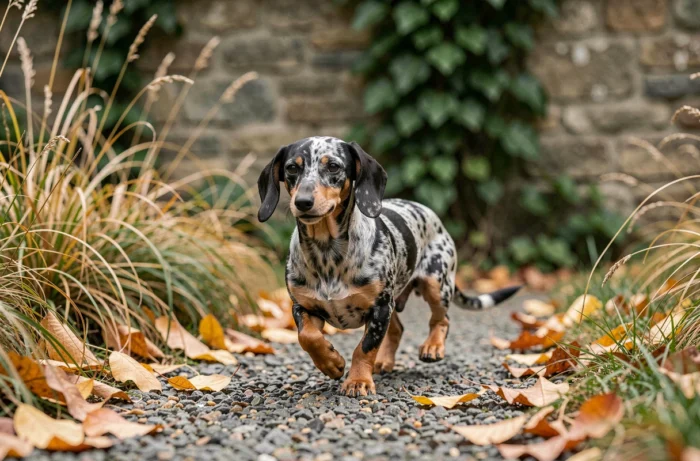
Miniature dapple Dachshund temperament: what size really changes
The miniature Dachshund retains the full hunting temperament of the standard Dachshund in a smaller frame. It is determined, clever, and sometimes downright stubborn. Its smaller size does nothing to diminish its tenacity or chasing instinct.
In practice, the miniature size mainly affects the intensity of two behavioral traits:
- Alert barking is proportionally more common in miniature Dachshunds. The dog compensates for its size with increased vocal vigilance—a trait to work on from an early age if you live in an apartment.
- Attachment to its primary person is often stronger, with a tendency toward separation anxiety if socialization has not included gradual periods of time alone.
- Reactivity toward larger dogs can take the form of disproportionate displays of aggression, inherited from the confidence of a badger hunter facing prey larger than itself.
The miniature Dachshund is not naturally a calm dog. Its energy level is moderate but steady, and its curiosity drives it to methodically explore every corner of its surroundings. A bored miniature dapple Dachshund will dig, scratch, and move whatever it can.
Training: consistency matters more than repetition
A common mistake is to keep repeating short recall sessions, assuming repetition will overcome the dog’s stubbornness. The miniature Dachshund learns quickly; it simply chooses not to obey when the motivation isn’t strong enough. Training works best with high-value food rewards (a meat treat, not kibble) and sessions that end before the dog loses interest.
House-training takes longer than it does with other breeds of a similar size. Expect it to take several weeks longer than with a Cavalier King Charles Spaniel or a Bichon, for example. Patience is non-negotiable.
Miniature dapple Dachshund health: the spine comes first
All Dachshunds are predisposed to intervertebral disc disease (IVDD). Their chondrodystrophic build (short legs, long back) places constant mechanical strain on the discs. Miniature Dachshunds remain just as susceptible despite their lower body weight.
Three practical measures can reduce the risk of onset or worsening:
- Prevent jumping on and off the sofa and bed. An access ramp is a necessity, not a comfort accessory.
- Maintain a strict healthy weight. Miniature Dachshunds gain weight easily, and every extra gram increases pressure on the discs.
- Limit stair use as much as possible. After IVDD surgery, the dog should only resume using stairs under veterinary supervision, never on its own.
Monthly weight checks are more reliable than visual estimates, especially for a short-haired dog whose silhouette can be misleading.
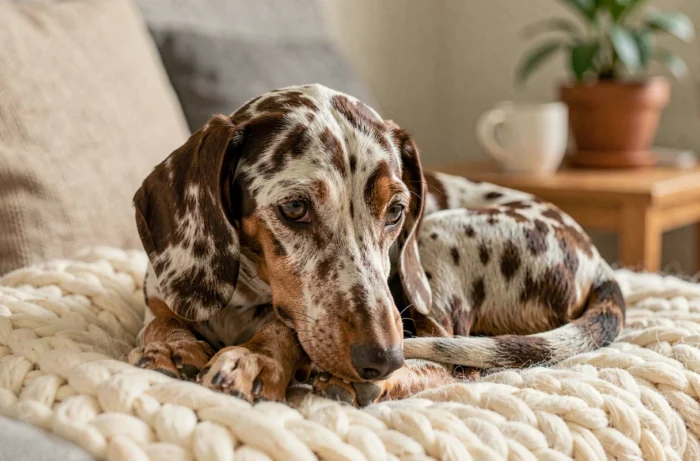
Specific considerations for the dapple coat
In addition to the disorders associated with double merles, dapple Dachshunds with partially depigmented irises (blue or heterochromatic eyes) should have regular eye examinations. Iris depigmentation does not itself cause visual impairment, but it can be accompanied by minor eye abnormalities that are detectable only during an examination.
Miniature dapple Dachshunds in families: compatibility and limitations
This dog can adapt to apartment living as long as it gets daily outings for stimulating walks. Miniature Dachshunds need to sniff, track, and explore. A fifteen-minute walk on a leash along the sidewalk is not enough.
Living with children works when they understand how to handle the dog properly. A Dachshund’s back must be supported at both the chest and hindquarters when lifting it. A child who picks the dog up under its front legs puts dangerous strain on its spine. This rule must be non-negotiable from the moment the puppy arrives.
Miniature dapple Dachshunds generally live as long as other miniature Dachshunds. Coat color does not affect lifespan, provided the dog is not the result of a double-merle mating and receives veterinary care suited to its build.
The visual appeal of the dapple coat should never take priority over checking genetic test results and hearing screening. A puppy with a striking pattern from a breeder who does not test their breeding dogs poses health and financial risks that the coat’s charm cannot outweigh.


