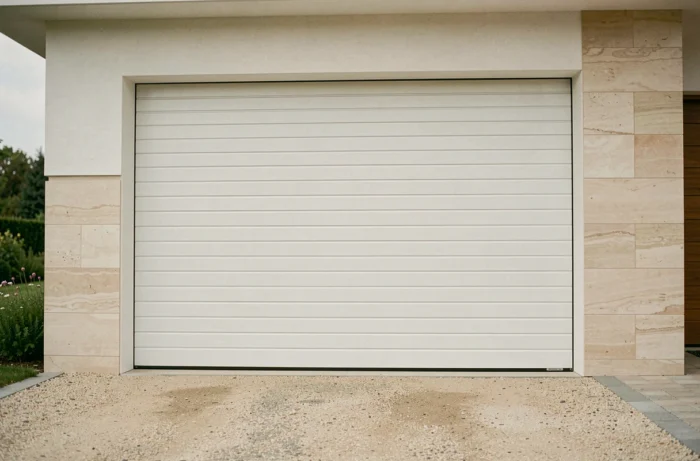
A 240 x 200 cm roller garage door fits most standard openings in detached homes. This size comes with specific technical constraints, particularly regarding the space required for the housing and the choice of motor, both of which determine the actual clear opening height and the level of security provided.
Housing dimensions and actual clear opening height for a 240 x 200 roller door
The stated dimensions of a roller garage door do not correspond to the clear height beneath the lintel. The roller housing, located at the top, takes up space and reduces the effective opening. For a 240 x 200 model, the housing typically takes up between 300 and 450 mm, depending on the slats’ roll diameter and the thickness of the integrated insulation.
There are two installation options. With an installation beneath the lintel, the housing sits inside the garage and reduces the interior height. With an installation behind the lintel, it fits into the masonry recess, provided the lintel is deep enough. The second option preserves the full 2,000 mm of clearance, but in most cases requires a lintel at least 350 mm deep.
We recommend measuring the lintel’s depth and height before placing an order. A difference of just a few centimetres may require a compact housing with thinner slats, which affects the curtain’s thermal insulation performance. The manufacturer’s instructions are the only reliable document for confirming compatibility between the opening dimensions and the housing of the chosen model.
Choosing a motorised 240 x 200 roller garage door therefore means checking these measurements in advance to avoid having to modify the masonry or accept a reduced clear opening height.
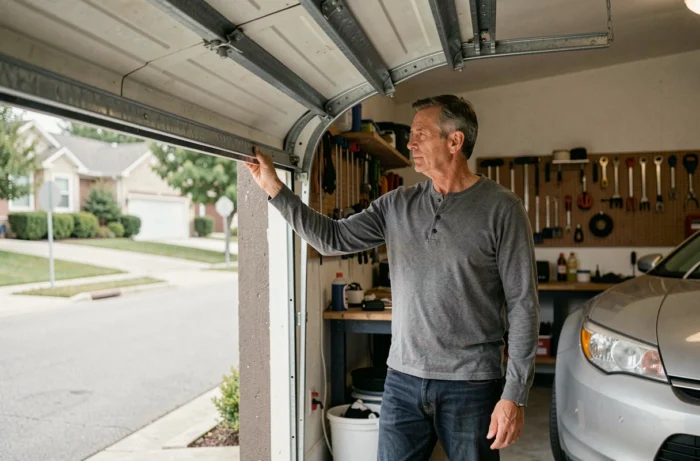
Roller garage door security: obstacle detection, safety edge and EN 13241 standard
The label “motorised door” does not guarantee a consistent level of safety. Detection equipment varies from one manufacturer to another and does not address the same risks.
- Photoelectric cells: these detect when an infrared beam positioned at the bottom of the opening is interrupted. They stop the curtain from closing if an obstacle crosses the beam, but do not respond to direct contact with the bottom slat.
- Safety edge: fitted to the bottom edge of the curtain, it reverses the motor when it makes physical contact with an obstacle. It addresses the risk of trapping that photoelectric cells alone cannot detect.
- Obstacle detection built into the motor: the motor measures resistance as the door closes and reverses its movement if it detects an overload. This feature complements the two options above but does not replace them, as its sensitivity depends on the factory settings.
The EN 13241 standard is the benchmark for checking whether a model complies with requirements. It covers garage doors and requires the manufacturer to provide a declaration of performance associated with the CE marking.
This marking confirms that the product meets its stated performance levels (wind resistance, safe operation), but it is not a burglary-resistance rating. A CE-marked product may not include a safety edge if the manufacturer has verified safety using another compliant device.
Before buying, compare the technical specifications line by line: whether photoelectric cells are included, the type of safety edge and the wind resistance class. Price differences between two 240 x 200 roller doors are often due to these features, not just the colour or finish of the aluminium slats.
Aluminium slats and insulation: what sets a high-performance curtain apart
For a roller door of this size, the curtain is made up of double-walled aluminium slats filled with polyurethane foam. The slat thickness and foam density determine thermal and acoustic performance.
Thinner slats reduce the roll diameter and allow for a more compact housing, but provide less insulation. Thicker slats, by contrast, improve the curtain’s thermal resistance at the cost of a larger housing. For a 240 x 200 model, this is a direct trade-off: every millimetre of slat thickness affects the space required for the housing and potentially the clear opening height.
The seal between the slats also deserves attention. A flexible lip seal provides an airtight barrier between each articulated slat. Wear can cause thermal bridges and let in noise. On entry-level models, this seal is sometimes missing or simply fitted without a flexible component.
Motorisation and manual release: prepare for a power cut
Without electricity, a motorised roller door with no manual release system will block access to the garage. This is often overlooked, especially when the garage is the only way into the home.
The manual release disconnects the curtain from the motor so the door can be operated by hand. Two mechanisms are available on the market:
- An interior emergency release winch, accessible only from inside the garage. It requires a separate pedestrian entrance, such as a side door or access through the house.
- An exterior key-operated release, which allows the curtain to be disengaged from outside. This option adds a mechanical access point that should be assessed for security against break-ins.
For a garage without a side door, the exterior key-operated release is the only viable option during an extended power outage. Check that it is listed in the product specifications before confirming your order.
Slat colour and finish: impact on durability
Powder coating and long-term colour retention
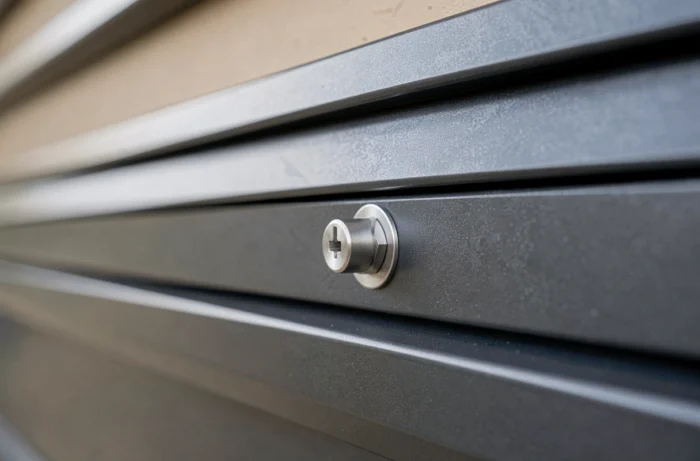
Aluminium slats are given a polyester powder coating that determines how well the colour withstands UV exposure. Dark colours (green, anthracite grey, black) deteriorate faster than light shades. Colour-retention warranties vary by manufacturer and do not always cover gradual fading.
Smooth or textured finish
A textured finish (wood-effect or stucco grain) hides minor scratches from everyday use better than a smooth finish. However, it makes the slats harder to clean, as the texture traps dust and pollution residue.
Choosing a colour for a 240 x 200 roller garage door is as much about maintenance as it is about appearance. A dark RAL colour on a south-facing façade requires more frequent maintenance to preserve its original appearance.


