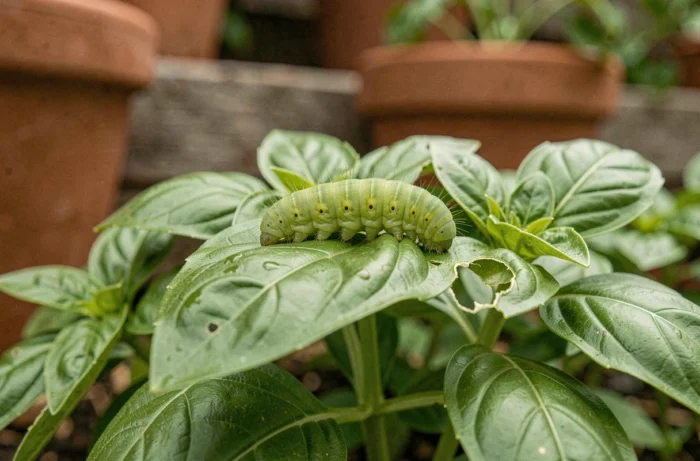
Holes in basil leaves, chewed right down to the veins, and a small green caterpillar blending into the foliage: it’s a familiar sight in the vegetable garden. These butterfly larvae settle in unnoticed and can devour an entire plant in just a few days if left unchecked. Understanding their life cycle and choosing the right response can save your harvest without resorting to chemical pesticides.
Life cycle of the green caterpillar on herbs
Before treating the problem, you need to know what you’re dealing with. Green caterpillars on basil are the larvae of lepidopterans (the large family that includes butterflies and moths). A female butterfly lays her eggs on the undersides of leaves, where they go unnoticed.
After hatching, the larva feeds on the foliage for several weeks. It grows, molts several times, then pupates and eventually emerges as a butterfly. The problem lies entirely in this larval stage: it’s the caterpillar that eats, not the butterfly.
Have you noticed small dark green pellets at the base of the plant? These are caterpillar droppings—a reliable sign of their presence, even when they remain hidden during the day. Some species hide under leaves or in the potting soil and only come out after dark.
One point is worth highlighting: a mild winter helps pupae survive in the soil. Caterpillar populations are then larger from early spring, and damage to young basil plants starts earlier in the season.
Several gardeners share their solutions for dealing with green caterpillars on basil online, and one piece of advice comes up time and again: act quickly. The sooner you take action, the less chance the colony has to establish itself.
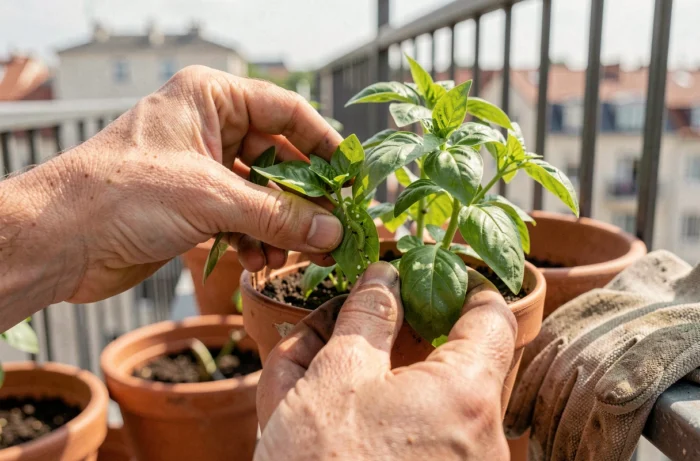
Green caterpillar or slug: how to identify basil damage
A hole in a basil leaf isn’t always the work of a caterpillar. Slugs and snails cause similar damage, and mistaking one for the other can lead to unnecessary treatments.
Signs that point to caterpillars
- Clean holes in the middle of leaves or irregularly chewed edges, with no shiny slime trail on the foliage.
- Small clusters of spherical droppings (caterpillar “poop”) visible on lower leaves or at the base of the plant.
- A green larva, sometimes striped with pale or yellow markings, a few centimeters long and curled up under a leaf.
Signs that point to slugs
If you find shiny, silvery trails on the leaves or pot, a slug is probably to blame. Slugs leave visible slime; caterpillars don’t. Slug damage is often concentrated on lower stems and young shoots close to the ground.
Identifying the culprit before taking action helps you avoid spraying Bacillus thuringiensis (which has no effect on gastropods) or setting beer traps (which don’t work against caterpillars).
Bacillus thuringiensis on basil: what to check before treating
Bacillus thuringiensis (Bt) is often presented as the go-to biological solution. These bacteria destroy a caterpillar’s digestive system once ingested. The treatment is targeted: it only affects lepidopteran larvae that eat treated leaves.
Bt does not work on eggs or adult butterflies. So it needs to be applied at the right time, when caterpillars are young and actively feeding. It is less effective against more mature larvae.
One point that guides often overlook: not every biocontrol product is automatically approved for every edible crop. Before using Bt on basil intended for consumption, the basic precaution is to check the product label and consult the official E-Phy catalogue to confirm that its use is authorized on herbs.
Spray in the late afternoon, when caterpillars come out to feed and the sun will no longer break down the bacteria. One application a week, repeated after rain, is generally enough to control a small population.
Protect basil without treatments: insect netting and companion plants
Curative treatment is only part of the solution. Preventing butterflies from laying eggs on basil is the most effective long-term approach.
Insect netting: a reliable physical barrier
Covering plants with fine-mesh netting keeps female butterflies away. The netting should be put in place before the first butterflies appear, so as soon as you plant outdoors. Make sure it is secured tightly to the ground or around the edge of the pot, with no gaps.
This technique has a clear advantage: it also protects against other vegetable garden pests, without using any products.
Companion plants: helpful, but no guarantee
You’ll often read that tansy, mint or thyme repel butterflies. Plant diversity is beneficial in the vegetable garden, but so-called repellent plants don’t create an impenetrable barrier. Butterflies can still lay eggs between two mint plants if the basil is accessible.
Think of companion plants as a way to diversify your garden, not as sufficient protection against a green caterpillar infestation.
Encourage natural caterpillar predators in the vegetable garden
Blue tits, parasitoid wasps and certain beetles actively feed on caterpillars. A garden that welcomes these beneficial creatures naturally keeps pest populations in check.
- Put up a nest box for blue tits near the vegetable garden: a family of blue tits eats a considerable number of insects and larvae during the breeding season.
- Leave some areas unmown or create woodpiles to provide a home for beneficial insects (ground beetles and rove beetles) that hunt at ground level.
- Avoid broad-spectrum insecticides, which kill beneficial predators as well as pests.
A diverse garden helps prevent caterpillar populations from exploding because every pest has a predator. Hand-picking is another simple and effective measure: inspecting plants twice a week and turning over the leaves is enough to remove caterpillars before they cause visible damage.
Basil is a resilient plant. A partially chewed plant will recover as long as growing conditions remain good (sunlight, regular watering and well-drained soil). Trim the damaged parts cleanly, and new leaves will take over within a few weeks.


