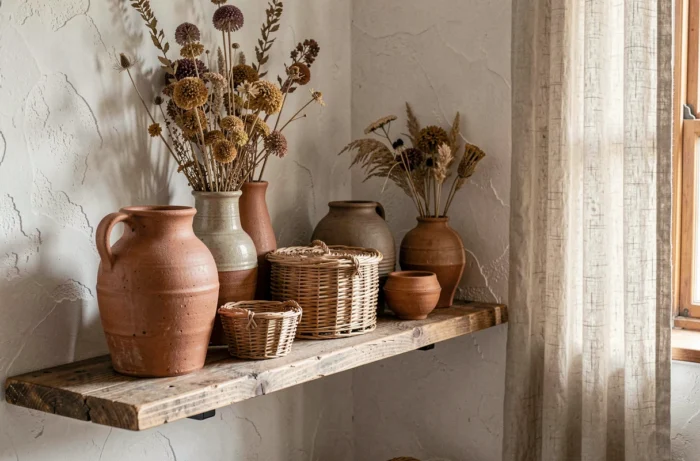
A poorly chosen or badly placed handcrafted object has the opposite effect to the one intended: it clutters the space instead of making it feel warmer. Artisan décor isn’t about accumulation, but about harmony between the materials, finish and scale of a room. Knowing how to identify a genuinely handmade piece, understand how it interacts with its surroundings and combine textures effectively helps create an authentic interior that stands the test of time.
Traceability of handcrafted objects: check before you decorate
The home décor market is full of pieces presented as handcrafted when they aren’t. An industrially moulded ceramic piece with a hand-applied glaze doesn’t have the same substance or subtle variations as one made entirely on a potter’s wheel. Before adding an object to your home, there are three things to check.
- Where it was made: ask for the exact place of production and the name of the workshop. A transparent artisan will readily share where they work and the techniques they use.
- The raw material: solid wood, stoneware, terracotta or raw linen are easy to distinguish from imitations by sight and touch. Genuine stoneware has variations in its grain that industrial moulding cannot reproduce.
- The finish: slight asymmetries, tool marks and irregularities in the glaze are hallmarks of handmade production. These details aren’t flaws; they are evidence of the artisan’s work.
The European ESPR Regulation (Regulation (EU) 2024/1781) establishes a framework for a digital product passport, with requirements to be defined gradually for each product category. The scheme aims to make information such as material origins and durability accessible. It doesn’t yet cover all home décor items, but it signals a broader shift towards greater transparency.
Browsing Cœur Artisan’s home décor, you’ll find product listings that specify the workshop of origin and the materials used, making it easier to check these details.
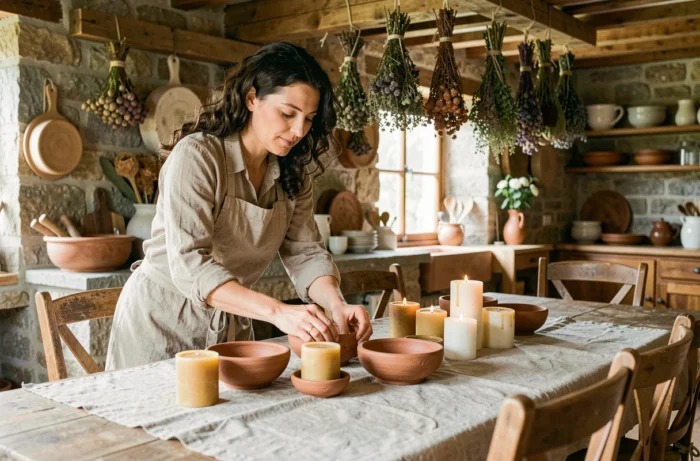
Handmade ceramics and raw wood: combine materials without cluttering the space
The most common mistake is using too many fine materials in the same space. Three material families are enough to create a cohesive, welcoming atmosphere. Any more, and the eye won’t know where to settle.
The principle of dominant materials and accents
Choose one dominant material for most of the visible surfaces (light wood, natural stone, lime plaster), then add one or two accent materials to change how a room feels. A solid oak table paired with a hand-thrown stoneware vase and a washed-linen textile creates a clear visual hierarchy.
Handmade ceramics work particularly well as accents. A terracotta serving dish on a raw-wood shelf is enough to add character to a kitchen corner. There’s no need to build an entire collection.
Scale and proportions in a space
A handcrafted object makes more of an impact when it has space around it. A medium-sized stoneware vase displayed on its own on a console table stands out more than one lined up among five other pieces. Authentic décor is all about restraint. Each object needs room to breathe so its texture and shape can be appreciated.
In small spaces, stick to one handcrafted object per visual plane. A woven-fibre light fixture on the ceiling and a ceramic bowl on the coffee table: two focal points are enough for a modest-sized living room.
Repairability of handcrafted pieces: a key to sustainable décor
The durability of a decorative object depends on more than just its material. A repairable object will stay in your home longer than a fragile one made from a fine material. A ceramic piece repaired using the kintsugi technique (with lacquer and gold powder) gains character. A rattan lampshade with a replaceable frame can extend the life of a light fixture by several years.
Before buying, check whether the artisan offers repairs or replacement parts. Some ceramicists take back chipped pieces to reglaze them. Basket makers can reweave a basket whose handle has broken. The option to repair is what sets genuine craftsmanship apart from disposable products disguised as authentic pieces.
We recommend always asking about repairability when you buy. The answer says a lot about the quality of the workmanship and the artisan’s commitment.
Colour palettes and handcrafted objects: create a cohesive atmosphere
Handmade objects bring their own colours, often derived from natural pigments or mineral glazes. These colours behave differently from industrial ones: they change with the light and firing process. Keep this in mind to avoid clashing tones.
White or cream walls let the warm tones of handcrafted pieces take centre stage: the ochre of terracotta, the deep brown of waxed wood, the olive green of a copper glaze. If your walls are already colourful, it’s best to choose objects in neutral tones (grey stoneware, bleached wood, natural linen) to avoid visual clashes.
Glazed ceramic pieces add a pop of colour to a room with a neutral palette. A single turquoise-glazed bowl on a natural-wood shelf draws the eye and creates a focal point effortlessly.
Natural light and how we perceive materials
Light can dramatically change how a handcrafted object looks. Matte stoneware can seem dull under cool white artificial lighting, but its full texture comes through in warm or natural light. Placing ceramic pieces near a window or under a warm-toned lamp brings out their surface irregularities.
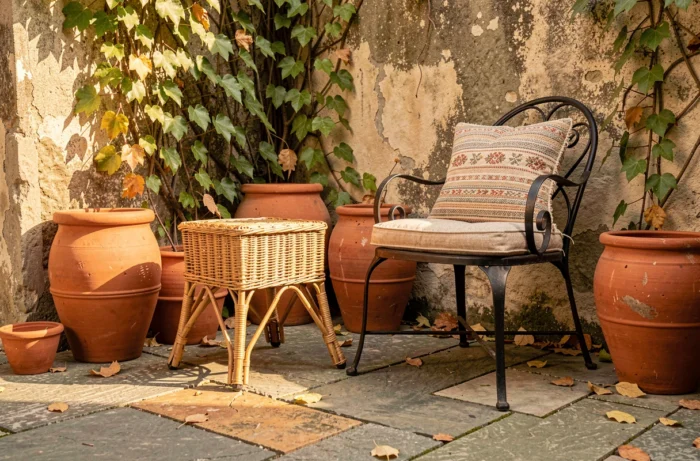
Handcrafted textiles (woven linen, felted wool, looped cotton) absorb light rather than reflect it, softening the atmosphere of a room. Pairing a matte textile with slightly glossy ceramics creates a subtle but effective contrast. This interplay between matte and satin-finish surfaces gives artisan décor its depth.
Authentic décor is built through a series of considered choices, not by accumulating objects. Every handcrafted piece added to a home should make sense in terms of material, proportion and light. When these three elements are in balance, even a few pieces are enough to transform a space into a warm, personal home.


