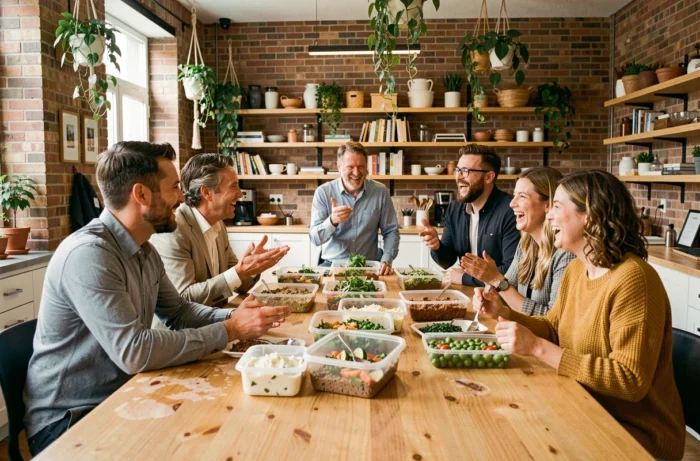
Midday arrives, plastic containers open in silence, and everyone eats in front of their screen. A few minutes later, they all head back without exchanging a word. This scenario plays out in most French offices. A team lunch at the office can become a genuine way to build cohesion, as long as it’s treated as more than just a way to distribute food.
Lunch breaks at the office: what the law actually requires
Before thinking about the menu or atmosphere, there’s one point worth your attention. The law provides for a minimum uninterrupted break of twenty minutes once the working day reaches six hours. If employees must remain available or respond to requests while they eat, this time may be reclassified as working time.
In other words, a team lunch where people continue handling work is not a break. It’s a meeting in disguise. And that’s precisely what discourages employees from taking part.
The physical space matters too. Companies with at least fifty employees must provide a dedicated dining area. Below this threshold, a suitable space is sufficient, but certain conditions apply if it is set up on the premises. A poorly ventilated kitchenette squeezed between the photocopier and the archives won’t make anyone want to sit down together.
Organizing a team meal with Libre Info lets you move beyond individual meal trays without turning the break into a logistical chore for the manager.
Hybrid work and group lunches: coordinating who’s in the office
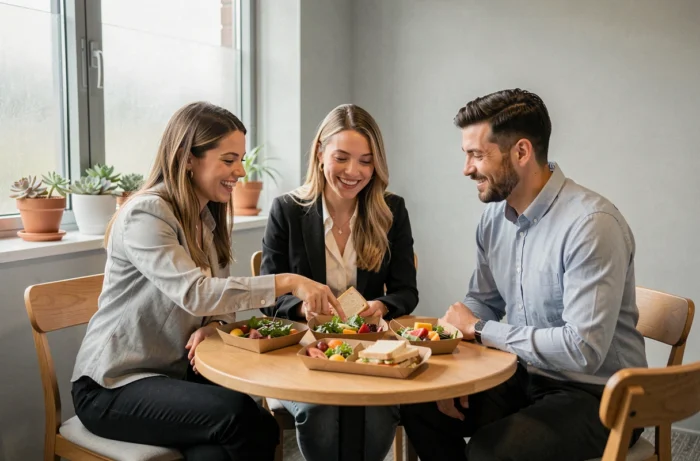
Have you ever organized a team lunch on a Tuesday, only to discover that half the group was working from home that day? Hybrid work remains widespread in the private sector. Its frequency has changed since 2021, but the mismatch between in-office days and remote-working days remains the main obstacle to sharing a meal.
The solution is simple: find out which day has the most employees physically in the office. Schedule the team lunch for that day, once or twice a month. A regular, predictable event works better than a spontaneous idea sent by email the day before.
There’s still the question of fairness. Colleagues working remotely that day shouldn’t feel left out. Consider rotating the chosen day each month, or arranging an equivalent for those working remotely (for example, having a good meal delivered to their home on the same day). Fairness in meal benefits extends beyond the days employees are in the office.
Team lunch formats: three options that change the dynamic
The usual format—a single-serve meal tray placed on the meeting table—doesn’t encourage interaction. To turn lunch into a chance to connect, rethink how you eat together.
Sharing dishes instead of handing out individual meals
Shared dishes placed in the middle of the table encourage everyone to pass them around, comment, and ask questions. This simple gesture—passing a salad bowl—creates an exchange that a sandwich in plastic wrap never will. Shared dishes spark more interaction than individual portions.
A monthly themed lunch
Choosing a food theme (Lebanese cuisine, seasonal vegetarian recipes, or a colleague’s regional specialties) gives people something to talk about beyond work. Teams that use this format find that informal conversations naturally continue after the meal.
A lunch with no assigned seating
A fixed seating plan reproduces the office silos. Letting people choose where to sit—or better still, deliberately mixing departments—gives colleagues who rarely cross paths a chance to get to know one another. A cross-department team lunch breaks down silos faster than a team-building workshop.

Organizing a team lunch without adding to the manager’s workload
The same question often comes up: who’s going to handle it? Booking, ordering, managing allergies, cleaning up. If all the work falls to one person, the team lunch becomes a chore and disappears after a couple of months.
Here are a few practical principles to make it sustainable:
- Assign a rotating pair each month. Two different people handle the order and logistics, then hand over to the next pair. Rotation prevents burnout and gets everyone involved.
- Set a clear, shared budget. The company covers the meal, or everyone contributes an agreed amount. Financial uncertainty kills the initiative more reliably than a lack of time.
- Keep the menu simple. Offer no more than two or three options, always including a vegetarian alternative. The fewer the choices, the less time ordering takes.
- Build cleanup into the schedule. Set aside fifteen minutes after lunch to tidy up together. This shared task is part of the group dynamic.
A team lunch that lasts depends on shared organization, not on one person’s goodwill.
What sharing a meal can actually change at the office
The benefits aren’t abstract. A team that eats together regularly develops informal communication habits. Difficult topics are easier to raise when you shared a meal the week before. New hires settle in faster when they’re invited to the table during their first week.
A team lunch doesn’t replace work meetings or off-site events. It serves a different purpose: a time when hierarchical relationships fade, people talk about something other than the current project, and they discover that a colleague shares their passion for hiking or fermentation.
Team cohesion is built through informal moments as much as formal meetings. A shared lunch is the most accessible of these moments. It requires no substantial budget, special room, or outside facilitator. Just a table, food designed to be shared, and protected time when nobody checks their notifications.


