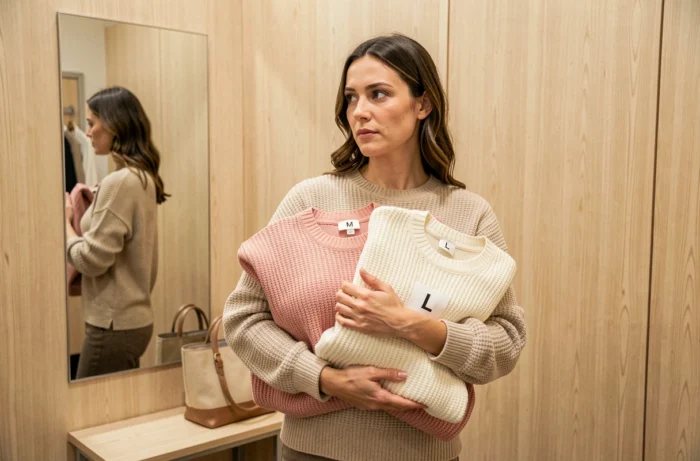
In France, no regulations require textile brands to use a unified sizing system. One brand’s M may correspond to another’s L, and the letter on the label says nothing about the garment’s actual fit. This lack of standardization explains why a significant number of online orders include several sizes of the same item, in the hope that at least one will fit.
When your upper and lower body measurements fall into different sizes
Size charts generally match three measurements (bust, waist and hips) to a single letter. The problem arises when those measurements don’t all fall into the same column.
A woman whose bust measurement points to an M and hip measurement to an L is left with a choice the chart can’t resolve. The answer depends on the garment: for trousers or a skirt, hip measurement takes priority, so choose the L. For a blouse or fitted top, bust measurement points to the M.
Choosing by garment is more reliable than looking for one size that works for your entire wardrobe. Understanding what a women’s size M corresponds to means matching the garment’s key measurement to your own body shape, rather than relying on a single letter.
Size and fit are two separate issues. Having the measurements for an M doesn’t mean you can’t prefer an L for a looser fit in a flowing dress, or find that an M runs large at a particular brand. Product pages that list the garment’s actual dimensions (shoulder width, back length, hip width in centimeters) are far more useful than a simple link to a general size guide.

Women’s size M and L conversion: what standard charts show
Most French brands use a chart similar to this one, though there can be noticeable differences from one retailer to another.
| Letter size | French size | Bust (cm) | Waist (cm) | Hips (cm) |
|---|---|---|---|---|
| M | 38 | 87-90 | 67-70 | 95-98 |
| L | 40 | 91-94 | 71-74 | 99-102 |
These ranges vary. At some retailers, M starts at 36; at others, it covers sizes 38-40. One brand’s M may correspond to another brand’s L. The only way to be sure is to measure yourself and compare your measurements with the chart for the brand you’re shopping, rather than a generic chart.
How to take accurate measurements
All you need is a flexible tape measure, a mirror and two minutes. Three measurements cover most women’s clothing:
- Bust: measure horizontally around the fullest part of your chest, without pulling the tape too tight or leaving it loose
- Waist: measure at your natural waist, usually two finger-widths above your navel, while breathing out normally
- Hips: measure around the fullest part of your hips, keeping your feet together
Take your measurements in your underwear, standing up, without sucking in your stomach. A two-centimeter difference in hip measurement can be enough to move you up or down a size.
Choosing between M and L based on the garment
A size chart gives you a starting point. Your final choice depends on what you’re buying.
Fitted tops and dresses
Bust measurement is the priority for a top, blazer or fitted dress. If you’re between sizes, choose based on the fit you want: go for M for a close fit, or L for a looser drape. Stretchy fabrics (jersey, knitwear) can accommodate an extra half-size, while rigid fabrics (poplin, linen) are much less forgiving.
Trousers and skirts
Here, hip measurement takes priority over all other measurements. Trousers cut for an M but worn by someone with L-size hips will pull across the thighs and feel tight around the hips. Conversely, L-size trousers on an M-size figure will gape at the waist, which is easier to fix (with a belt or alterations) than a pair that’s too tight around the hips.
Oversized garments and straight cuts
For a coat, loose sweater or A-line dress, the difference between M and L is often barely noticeable. Choose the size that fits your largest measurement, without trying to tailor the fit.

Limitations of digital tools and online size guides
Virtual fitting rooms and size recommendation tools are becoming increasingly common on fashion websites. Their promise is to reduce returns by helping shoppers choose the right size before buying. In practice, seeing a garment on an avatar doesn’t guarantee that you’ll know your actual size. The result depends on how accurately the garment is rendered and how precise the body measurements entered by the user are.
Static size guides (PDF charts or web pages) remain the most widely used tool. Their main limitation is that they don’t account for the garment’s cut, fabric stiffness or differences between upper- and lower-body measurements. Ordering several sizes of the same item is still common, a sign that these tools don’t always solve the problem.
The most reliable approach combines three habits: measure your bust, waist and hips; check the chart for the brand you’re shopping; and, when available, read the garment’s actual dimensions on the product page. This last step makes all the difference, because it sidesteps the ambiguity of an M or L and gives you measurements in centimeters that you can compare across brands.
No letter on a label can replace a tape measure and the size chart for the brand you’re shopping. The most effective approach, both in terms of time and return costs, is to choose based on the garment and its key measurement rather than looking for one size that works for your entire wardrobe.


