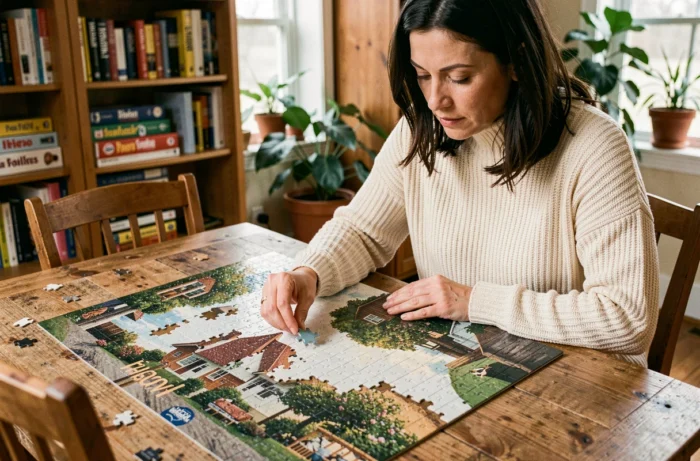
Two terms come up whenever people look for a name for someone passionate about puzzles, but neither appears in a standard dictionary. One comes from Greek, the other from English. Their coexistence says a lot about a community taking shape without waiting for linguists’ approval.
Céphaloclastophile and dissectologist: the etymology and status of each term
The word céphaloclastophile was proposed by Hellenist Denis Liégeois. It combines three Greek roots: kephalê (head), klastós (broken) and philos (friend, enthusiast). Literally, it refers to someone who loves brainteasers.
The term dissectologist comes from the English word dissectologist, used in the 19th century to describe people who assembled cut-out puzzles. It remains more common in the English-speaking world.
| Term | Linguistic origin | Literal meaning | Listed in an official dictionary |
|---|---|---|---|
| Céphaloclastophile | Greek (kephalê, klastós, philos) | Friend of brainteasers | No |
| Dissectologist | English (dissectologist) | Specialist in cutting out and assembling puzzles | No |
Neither word has been approved by the Académie française. The Guichet du Savoir at the Lyon Municipal Library confirms that céphaloclastophile remains a usage-based neologism, picked up by media outlets such as Vosges Matin and France 3 Régions, but without institutional recognition. So when asking what do you call a puzzle enthusiast, the answer depends more on the community you’re addressing than on any established standard.
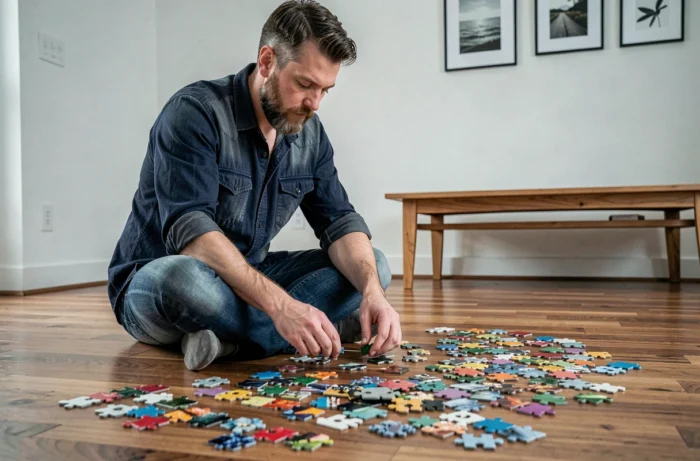
Visuospatial abilities and puzzles: what studies really show
Regular puzzle-solving is often associated with cognitive benefits. The available evidence suggests this claim should be treated with caution.
A 2018 study published in Frontiers in Aging Neuroscience found a link between puzzle experience and various visuospatial abilities in adults aged 50 and over. This finding is observational, not causal: it does not show that doing puzzles improves these abilities.
A randomized trial conducted by Fissler and colleagues found that adults aged 50 and over, after one month of practice, got better at the puzzle task itself. However, no significant improvement in overall visuospatial abilities was measured compared with the control group.
Puzzles and dementia prevention: be wary of promises
Several general-interest sources present puzzles as a safeguard against cognitive decline. Current evidence does not support this claim with certainty. Research has found associations between mentally stimulating activities and cognitive maintenance, but these do not constitute proof of prevention.
Puzzles engage patience, pattern recognition, working memory and hand-eye coordination. These demands are real. Claiming that they provide lasting protection for the brain goes beyond what published findings allow us to conclude.
Personality traits associated with puzzle enthusiasts
Beyond cognitive abilities, a passion for puzzles draws on identifiable behavioral traits. Assembling pieces, sometimes by the hundreds or thousands, involves a particular relationship with time and frustration.
- Tolerance for ambiguity: a céphaloclastophile accepts not seeing the result right away. A session often ends without the puzzle being completed, which requires the ability to keep going without an immediate reward.
- Attention to fine details: spotting a subtle color variation or connector shape among hundreds of pieces calls for sustained visual discrimination, which is different from simple concentration.
- A preference for process over results: several online communities report a sense of emptiness after completing a puzzle. What motivates them is not the final image, but the act of putting it together.
These traits are not exclusive to puzzle enthusiasts, but their combination in a single activity explains why their profile differs from that of people who enjoy other so-called “quiet” pastimes, such as coloring or reading.

Jigsaw puzzle: vocabulary that reflects distinct practices
The English term jigsaw puzzle (literally, “jigsaw-cut puzzle”) refers to the tool used in the 18th century to cut the first maps into pieces for educational purposes. In French, “puzzle” covers both mechanical brainteasers and flat jigsaw puzzles.
This linguistic distinction is not trivial. Fans of 3D puzzles, wooden brainteasers or mechanical puzzles may not identify with the same label as enthusiasts of traditional jigsaw puzzles. The word céphaloclastophile theoretically covers all these profiles, since it refers broadly to someone who enjoys brainteasers.
Children and adults: two different relationships with puzzles
For children, puzzles are first and foremost a tool for learning spatial skills and developing fine motor skills. The pieces are large, the images simple and the number of pieces limited. The educational goal takes priority over the challenge.
For adults, the activity shifts toward seeking ever-greater complexity. Puzzles with thousands of pieces, monochrome versions and editions without a reference image all point to a desire for a carefully calibrated challenge. The shift from educational tool to personal challenge marks the emergence of the céphaloclastophile.
The term remains a neologism, the community is taking shape online, and scientific evidence calls for caution about the supposed cognitive benefits. What is clear, however, is that a passion for puzzles is rooted in a relationship with time, patience and process that few other activities engage with the same intensity.


