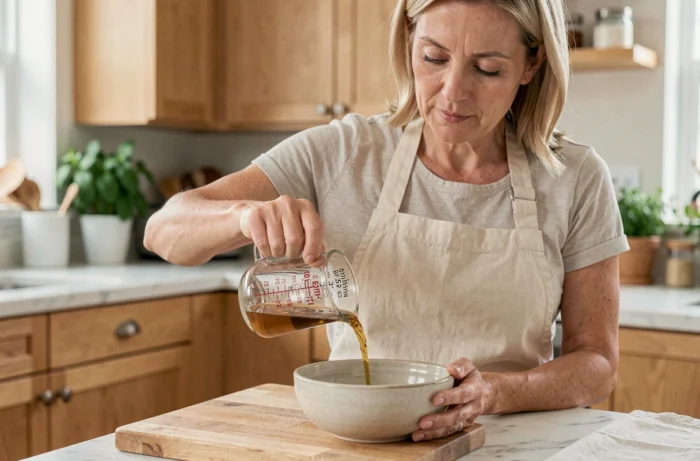
In the kitchen, French recipes sometimes give measurements in milliliters and sometimes in centiliters. When a cookbook or website calls for 80 ml of milk, cream, or stock, the same question always comes up: how many centiliters is that? The answer is a simple division by ten, but this basic calculation doesn’t solve the measurement pitfalls that can arise in the kitchen.
Measuring 80 ml without a measuring cup: the real kitchen challenge
Converting 80 ml to cl is mathematically straightforward: 80 ml is exactly 8 cl. You divide by ten because the prefix “centi” means one hundredth of a liter (or ten milliliters), while “milli” means one thousandth. The formula works for any liquid, regardless of its density.
The challenge comes when it’s time to measure out those 8 cl. A graduated measuring cup solves the problem in seconds, but not every cook has one on hand. That’s when estimates start creeping in—and when a recipe’s accuracy can suffer.
Before looking for a substitute, it helps to convert 80 milliliters to centiliters to get a clear sense of the actual amount: about three-quarters of a small, standard mustard glass.
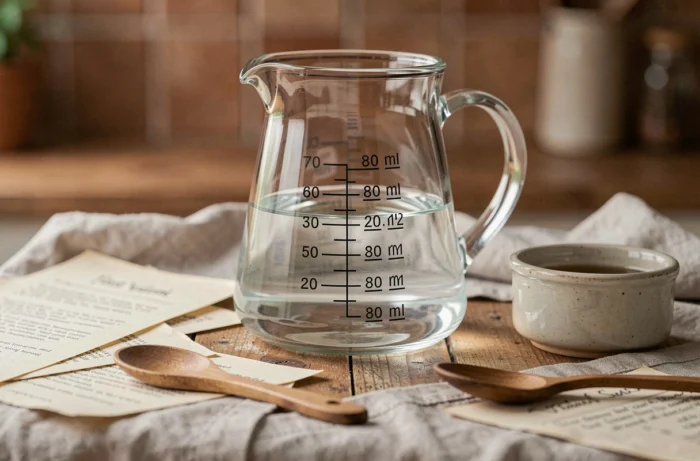
Why an ordinary tablespoon only gives an approximate measure
A tablespoon is the first thing many people reach for when they don’t have a measuring cup. A level tablespoon holds about 15 ml of liquid. So, to reach 80 ml, you’d need a little more than five tablespoons. In theory, five tablespoons give you 75 ml, and a sixth takes you over the target.
This calculation assumes that every tablespoon holds exactly 15 ml. In practice, the actual capacity of a spoon varies depending on its shape and manufacturer. An old-fashioned tablespoon, a slightly larger dessert spoon, or a cafeteria spoon—none of these utensils is calibrated. The difference between two spoons from different drawers can amount to several milliliters per measure.
For a vinaigrette, this margin of error doesn’t matter. For a delicate crêpe batter or chocolate ganache, a few milliliters too much or too little can noticeably change the texture. So the question isn’t how many centiliters 80 ml makes, but whether the measuring tool you’re using is reliable.
Practical ways to measure 8 cl without a graduated measuring cup
If you don’t have a measuring cup or kitchen scale, a few everyday items can help you get close to 80 ml with reasonable accuracy:
- A standard mustard glass (such as a Bonne Maman jar) holds about 100 ml when filled to the brim. Filling it to four-fifths gives a reasonable estimate of 80 ml.
- An espresso cup generally holds between 60 and 80 ml. Filling it to the brim will often give you the right amount, but it depends on the model.
- Kitchen measuring spoons (sold in sets of four or five) have calibrated capacities, unlike table cutlery. Five 15 ml tablespoons, plus one 5 ml teaspoon, give you exactly 80 ml.
Measuring spoons are the only reliable substitute for a graduated measuring cup. All other household containers provide only an estimate.
Volume and weight: the mix-up that throws off measurements
Knowing that 80 ml equals 8 cl doesn’t tell you how much the measured ingredient weighs. For water, skim milk, or clear stock, 80 ml weighs about 80 grams because their density is close to that of water. This volume-to-weight equivalence makes recipes easier to follow, and many cooks apply it by default to all liquid ingredients.
That rule doesn’t hold for olive oil, heavy cream, or honey. Oil is less dense than water, so 80 ml of oil weighs less than 80 grams. Honey is much denser and weighs more for the same volume. Treating a volume as a fixed weight can throw off a recipe as soon as you move beyond water-based liquids.
Dry ingredients: volume doesn’t indicate weight
The confusion gets worse with dry ingredients. Flour, powdered sugar, and ground almonds take up very different amounts of space for the same weight, depending on whether they’re packed, sifted, or simply poured. An 80 ml container filled with flour weighs nothing like an 80 ml container filled with granulated sugar.
For dry ingredients, a kitchen scale removes all ambiguity. Professional baking recipes also give quantities in grams rather than milliliters for precisely this reason.

Milliliters to centiliters conversion chart: common kitchen measurements
For recipes that switch between milliliters and centiliters, a reference chart saves you from repeating the same calculations. The rule is always the same: divide milliliters by 10 to get centiliters.
| Milliliters (ml) | Centiliters (cl) | Practical equivalent |
|---|---|---|
| 5 ml | 0.5 cl | 1 teaspoon |
| 15 ml | 1.5 cl | 1 tablespoon |
| 50 ml | 5 cl | One small liqueur glass |
| 80 ml | 8 cl | Mustard glass filled to 4/5 |
| 100 ml | 10 cl | 1 mustard glass |
| 250 ml | 25 cl | 1 large glass |
| 500 ml | 50 cl | 1 half-liter |
The metric system makes these conversions predictable: each step is a multiple of ten. No complex formula, no variable conversion factor. Any errors come from the measuring tool, not the calculation itself.
For recipes from the US or UK that use cups or fluid ounces, converting to centiliters requires a different factor (1 US cup is about 24 cl). In that case, it’s best to have a set of calibrated measuring cups or a measuring cup marked with both systems.
Next time a recipe calls for 80 ml, you’ll know what to do: measure out 8 cl, or a little less than a mustard glass. If precision matters, a set of measuring spoons costs just a few dollars and makes every measurement repeatable, recipe after recipe.


