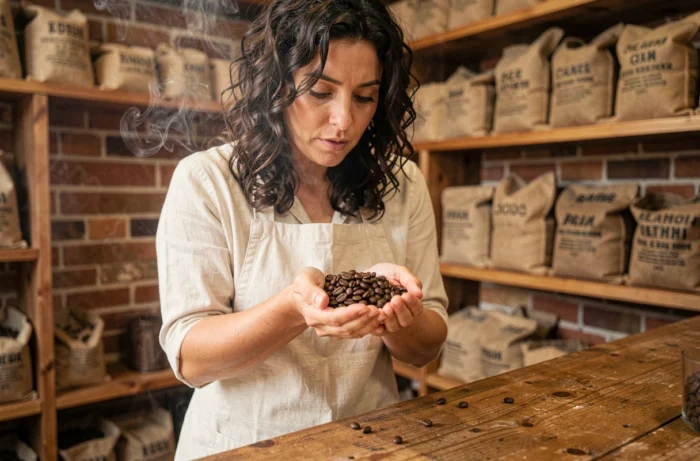
The quality of a coffee is determined before it reaches your cup, often even before you buy it. Choosing a quality coffee to bring out all its aromas means understanding what happens between the harvested cherry and the cooled bean, and then between opening the bag and brewing. Three technical factors determine the result in the cup: the roast profile, the bean’s true freshness, and the match between grind size and brewing method.
Post-roast cooling and aromatic development
Roasting defines the aromatic profile, but the cooling process that follows immediately afterward affects the final result. A bean that cools too slowly continues to cook from residual heat: volatile aromatic compounds break down, the body becomes flat, and notes of ash or rubber may emerge.
Two methods are commonly used. Forced-air cooling stops the Maillard reaction within minutes without adding moisture. Quenching (water misting) cools the beans faster, but leaves residual moisture that accelerates oxidation if the beans are not packaged quickly.
A reputable artisan roaster will mention its cooling method or be happy to discuss it. This detail, rarely shown on the packaging, can distinguish a carefully controlled batch from a merely decent one. We recommend asking directly, especially when buying from a roastery or ordering from a made-to-order roasting website.
Professionals who document their entire supply chain, from green coffee selection to packaging, are sometimes listed in specialist directories such as calcea.fr, making it easier to identify suppliers who are transparent about their processes.
Freshness of whole-bean coffee: the peak and its limits
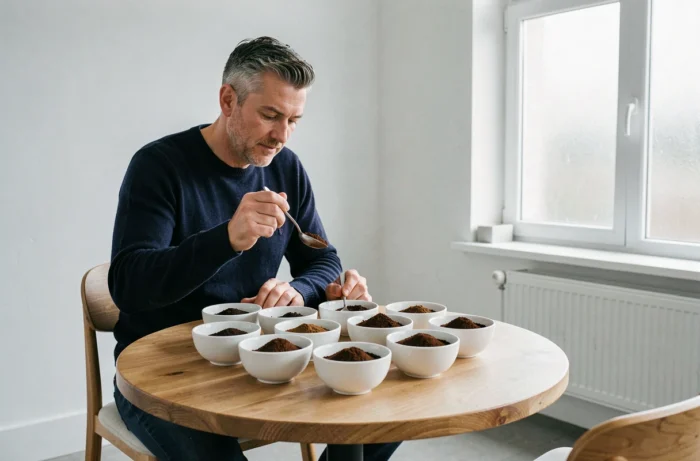
A coffee’s aromatic peak falls between ten days and three months after roasting. Before ten days, CO₂ degassing is still too active for a stable extraction, especially for espresso. After three months, oxidation has consumed most of the volatile compounds responsible for fruity, floral, or spicy notes.
Ground coffee loses its aromas much faster than whole beans: the surface area exposed to oxygen is incomparably greater. Buying whole beans and grinding them just before brewing is still the only way to preserve their aromatic potential over time.
What the packaging does (and doesn’t) tell you
The roast date printed on the bag is the most reliable indicator. A best-before date alone says nothing about actual freshness. A bag fitted with a one-way degassing valve offers better protection than standard packaging, but it cannot make up for months of warehouse storage.
Compostable packaging is becoming more common, which is a positive development for the environment. However, its barrier against moisture and oxygen is sometimes weaker than that of a multilayer aluminum bag. Even an exceptional coffee can lose its edge within weeks if stored in permeable packaging.
Grind size and brewing method: the pairing that determines what’s in your cup
A grind size that doesn’t suit the brewing method results in either under-extraction (a watery, acidic cup with little body) or over-extraction (dry bitterness and astringency). Even the most traceable coffee in the world can’t make up for an incorrect grind size.
- Espresso: fine, even grind; short contact time (twenty-five to thirty seconds). Pressure amplifies inconsistencies, so a conical or flat burr grinder is preferable to a blade grinder.
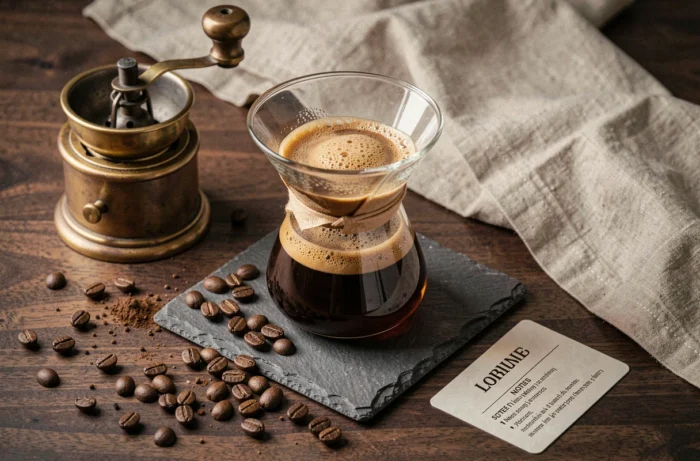
- Filter (V60, Chemex, dripper): medium grind; contact time of three to four minutes. The clarity of the cup highlights the coffee’s origin notes, provided it has been roasted to a light-to-medium profile.
- French press: coarse grind; four-minute immersion. The metal filter lets oils through, creating a full-bodied cup but potentially masking the subtle notes of a lightly roasted specialty coffee.
- Moka pot (Italian coffee maker): a grind between fine and medium. The high temperature and pressurized steam bring out roasted and chocolate notes, making this method better suited to medium-to-dark roasts.
Origin, variety, and traceability: look beyond the “100% arabica” label
The label “100% arabica” does not guarantee quality coffee. Arabica refers to a species (Coffea arabica), not a quality grade. An arabica grown at low altitude, mechanically harvested, and stored for months in a container may taste bland. A lot of the same species, grown at high altitude, hand-picked at peak ripeness, and dried on African raised beds, will have a far richer aromatic profile.
Botanical varieties (Typica, Bourbon, Gesha, SL28, Catuai) influence the profile just as much as the terroir. A specialty coffee product description lists the variety, altitude, producer, and drying process. If this information is missing, that’s a warning sign: the roaster either doesn’t know the lot or prefers not to provide details.
Processing methods and the flavor in your cup
Post-harvest processing has a strong influence on aroma. Washed coffee produces a clean cup with defined acidity and floral or citrus notes. Natural (dry-processed) coffee develops fermented, fruity, and sometimes wine-like notes. Honey processing falls between the two, with more pronounced sweetness and a rounded body.
Specialty coffees consistently specify the processing method. Choosing between washed, natural, or honey means choosing an aromatic style, not a quality level. What matters is that the process is well controlled and consistent with the roast profile used afterward.
The European Union Deforestation Regulation (EUDR) now requires importers to meet due diligence and geolocation obligations. Labels such as “sustainable” or “responsible” on a bag are no longer enough to demonstrate compliance: checking that the roaster documents its supply chain remains the safest approach.
A coffee that reveals all its aromas is one where every step has been carefully considered: a variety suited to the terroir, controlled drying, a tailored roast profile, rapid cooling, protective packaging, and a grind calibrated for the right brewing method. No single step can compensate for another, and it is precisely this combined attention to detail that sets good coffee apart from ordinary coffee.


